Stainless Steel Fibre Fabric: When Buyers Choose Steel Over Silver and Copper-Nickel
Steel, silver and copper-nickel each win on a different job. This guide compares them on durability, care, cost and use, so buyers choose by the job, not by one number.
Stainless Steel Fibre Fabric: When Buyers Choose Steel Over Silver and Copper-Nickel
Shielding fabric buyers usually start with three names: silver fibre, copper-nickel, and stainless steel fibre. The mistake is to choose between them by one number. A shielding figure describes one piece of fabric under one test; it says nothing about how the fabric feels, how it survives washing, what it costs at volume, or whether it suits the job it will actually do. This guide compares stainless steel fibre fabric with silver fibre and copper-nickel fabric on the points that decide a real order — durability, care, cost, hand feel and use — so a buyer chooses by the job, not by one number.
The three materials, and what each one is good at
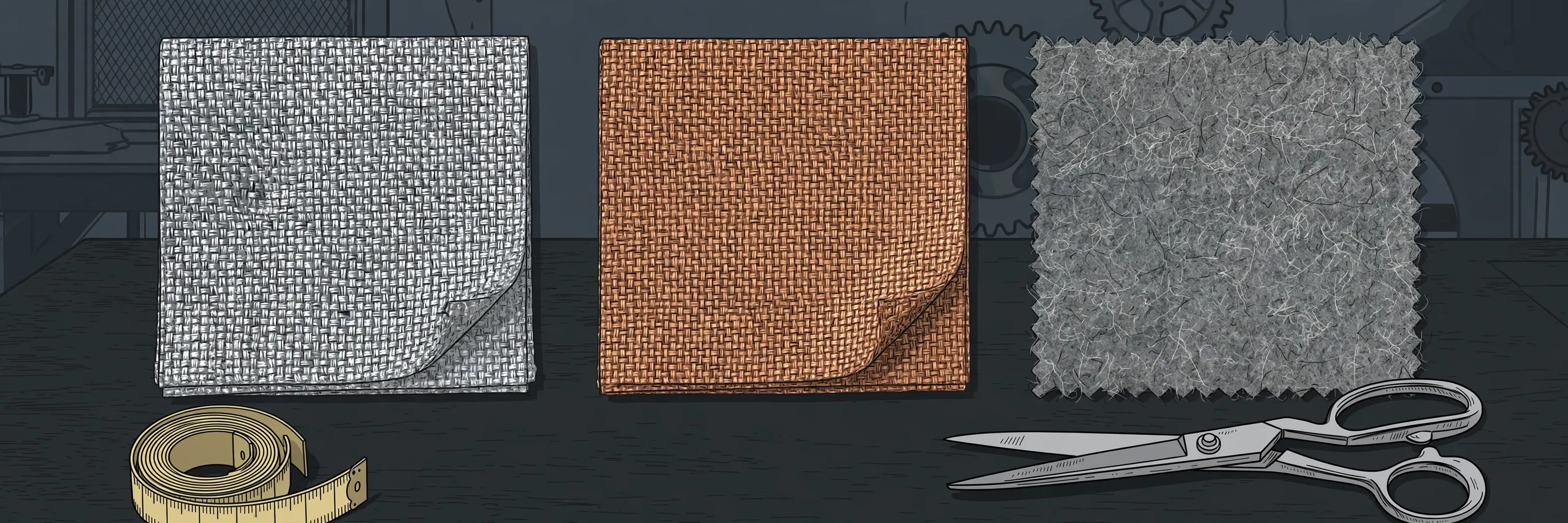
Silver fibre fabric is the softest of the three and the closest to an ordinary textile. It is listed at 50 to 80 decibels in the product guides on this site, and it is the usual choice for garments, bedding and anything worn next to the skin, because it drapes, breathes and feels like clothing. Copper-nickel fabric is listed at 60 to 90 decibels and is the usual choice for linings, enclosures, covers and curtains, where a higher shielding figure and an easy, flexible fabric matter more than a soft hand feel. Conductive foam, listed above 75 decibels, is used for gaskets and seals rather than as a fabric.
Stainless steel fibre fabric is the third option, and it wins on a different set of points. Steel fibre is hard-wearing: it resists abrasion, holds its shape, and suits products that are folded, handled, walked on or cleaned often. It is often chosen for workwear, industrial covers, curtains in busy rooms, and products where the fabric has to last rather than feel soft. Its shielding depends on the fibre content, the blend and the weave of the exact fabric, and no single figure describes every steel fibre fabric. A buyer who asks for the test report of the exact fabric — with the test method named and the result in writing — gets a real answer; a buyer who asks for "the steel fabric number" gets a brochure figure that may not match the roll they receive. Test reports and supplier certificates are available on request.
The point is not that one material is better. The point is that each one wins on a different job, and the job should be named before the material is chosen. A soft garment, a tough industrial cover and a room lining are three different orders, even if all three need shielding.
Durability and care: where steel earns its place
Durability is where stainless steel fibre fabric usually earns its place. A fabric that is folded every day, pulled across a floor, brushed against equipment or washed on a regular cycle needs fibres that do not break, wear thin or lose their conductivity at the fold. Steel fibre is chosen for that reason: for workwear that is worn and washed as work clothing, for covers that are put on and taken off, for curtains that are opened and closed every day, and for mats and linings that take foot traffic or handling.
Silver fibre and copper-nickel fabrics are not fragile, but they are chosen for different strengths. Silver fibre wins where softness and skin contact matter; copper-nickel wins where flexibility and a high shielding figure matter. If the product will be handled roughly, cleaned often or used in an industrial setting, say so in the first message, because the supplier will propose a different fabric — often a steel blend — than for a soft garment. If the product will be worn next to the skin, say that too, because hand feel then matters as much as durability, and the choice may go the other way.
Care is the second half of durability. Before you order, agree the cleaning method with the supplier: the temperature, the detergent type, the cycle, and whether the product is machine washed, hand washed or dry cleaned. Agree how the product will be tested after cleaning, on the finished product rather than on a flat piece of fabric, and agree what counts as a pass. Do not accept a wash count from a brochure. How many washes a product survives depends on the fibre, the blend, the construction and the washing method together, and no supplier can promise a count for a product that has not been made and tested yet. Ask instead for the test plan: which product will be washed, how it will be washed, how it will be tested after washing, and what counts as a pass.
Cost, hand feel and the trade-off buyers actually make
Cost is the reason most buyers ask about steel in the first place, and it is the point where a single price comparison misleads. The price of a roll depends on the fibre content, the blend, the weight and the width, and a cheaper roll that fails the test, wears out early or cannot be sewn the way the product needs is the expensive order. Compare the cost of the finished product that passes the test, not the cost of a roll that has not been tested. Ask the supplier to quote the fabric that meets the brief — the fibre content, the weight, the width and the test — rather than the cheapest fabric on the list, and ask what is included in the price: the test report, the sample, the cutting, and the documents.
Hand feel is the trade-off that decides most steel orders. Steel fibre fabric is firmer and heavier in the hand than silver fibre fabric, and that matters when the product is worn, slept on or touched often. A workwear jacket can carry a firmer fabric; a bed canopy or a base layer usually cannot. If the product touches the skin, order a sample and wear it before you approve bulk. If the product is a lining inside another fabric, hand feel matters less, and steel becomes an easier choice. Tell the supplier who will touch the fabric and how often, and ask which fabric they would propose for that use.
Colour and finish are the third part of the trade-off. Steel fibre blends are usually chosen in their natural tones, and dyeing or finishing can change the hand feel and the shielding, so say before sampling whether the product will be dyed or printed, and ask the supplier to sample the finished fabric, not the undyed roll.
Choosing by the job: a short checklist
Choose stainless steel fibre when the product is handled, folded or cleaned often, when abrasion resistance matters, when the fabric is a lining or a cover rather than a next-to-skin layer, and when the budget needs a workhorse fabric that lasts. Ask for the test report of the exact fabric, with the fibre content, the weight, the width and the test method named, and test the finished product, not only the roll.
Choose silver fibre when the product is worn next to the skin, when softness and drape matter, and when the product is a garment, a bedding item or a wearable. Choose copper-nickel when the product is a lining, an enclosure, a cover or a curtain, when flexibility and a high shielding figure matter, and when the fabric will be cut, bonded and sewn into a fixed installation. In every case, name the shielding target and the test you want in the same message, and ask for the test result in writing, with the test method named.
Do not choose by one number, and do not assume a document that applies to a roll of fabric automatically applies to a finished product in your market. The supplier can propose a fabric, supply a sample and report a test result in writing; the decision about whether that result meets your customer's specification is yours and your customer's.
Samples, quantities and what to check
Fabric can be ordered from as little as 1 square metre. The suggested starting quantity is 10 square metres or 10 metres, with a better price for a larger quantity, and silver fibre fabric is usually priced by the square metre while copper-nickel fabric is usually priced by the metre. Finished products in stock can be ordered from 1 to 2 pieces, while an out-of-stock item needs a new quotation and lead time. Say whether you are ordering fabric by the roll or finished products, give the width, and say whether the fabric will be cut, sewn, bonded or hung.
A stock sample usually ships in 1 to 5 days, while a custom sample usually takes 5 to 30 days depending on the process, and the exact time is confirmed once the specification is confirmed. For a steel fibre fabric, order the sample in the exact blend and weight you will buy, and test the finished product as it will be used: sewn, folded, and cleaned by the agreed method. When it arrives, check the fabric, the edges, the seams and the hand feel first, then run the agreed checks on the finished piece, and keep the result with the sample. Ask for the documents you need with the sample, not with the bulk order, so a missing document is found while the order is still small.
Payment is by letter of credit, telegraphic transfer, PayPal or Western Union. Confirm the method and the currency before the order is placed. Yiwu Zimo Trading Company is a trading-and-manufacturing supplier. The details above describe how it quotes and samples; they do not describe factory capacity or production processes, which are not published, and they do not promise a shielding level for a fabric that has not been tested.
Frequently asked questions
When should we choose stainless steel fibre fabric?
When the product is handled, folded or cleaned often, when abrasion resistance matters, and when the fabric is a lining, a cover or workwear rather than a next-to-skin layer.
What shielding figure does steel fibre fabric reach?
It depends on the fibre content, the blend and the weave of the exact fabric. Ask for the test report of the exact fabric, with the test method named and the result in writing, and test the finished product.
How does steel compare with silver and copper-nickel?
Silver fibre, listed at 50 to 80 decibels, is the softest and the usual choice next to the skin. Copper-nickel, listed at 60 to 90 decibels, is the usual choice for linings, enclosures and curtains. Steel wins on durability and hard wear.
Can steel fibre fabric be washed?
Agree the washing method before ordering, wash the sample by that method, and test the finished product after washing. Do not accept a wash count from a brochure.
How long does a sample take?
A stock sample usually ships in 1 to 5 days. A custom sample usually takes 5 to 30 days depending on the process, and the exact time is confirmed once the specification is confirmed.
Your next step
Write a one-page brief with the product and how it will be used, the fabric and the fibre content you want tested, the shielding target and the test method, how the product will be cut, sewn, bonded or cleaned, the quantity in the unit the supplier prices in, the width, the documents you need, and the payment method and currency. Send it and ask the supplier to confirm the fabric, the sample time, the test that will be run on the sample, and what is included in the sample price. When the sample arrives, test the finished product before you approve bulk. If you are ready to start, contact us through the contact page or email info@zimo-cn.com with your brief, and we will reply with a fabric proposal, a sample time and a quote.