How to Brief a Shielding Fabric Supplier: A One-Page RFQ Template for Buyers
A clear brief gets a faster, more accurate quote. This guide gives buyers a one-page RFQ template for shielding fabric, and explains what each line is for.
How to Brief a Shielding Fabric Supplier: A One-Page RFQ Template for Buyers
A shielding fabric quote is only as good as the brief behind it. A buyer who writes "please quote shielding fabric" will get a slow reply full of questions, or a fast reply that quotes the wrong fabric. A buyer who sends a one-page brief — the fabric, the use, the size, the quantity, the documents and the timing — will get a quote that can be compared, a sample that matches the product, and a first order without surprises. This guide explains what a good brief contains, and gives a one-page RFQ template a buyer can copy and send.
Why suppliers ask so many questions
A supplier that sells shielding fabric does not sell one product. Silver fibre fabric and copper-nickel fabric behave differently, are priced differently, and suit different products. Silver fibre fabric, listed at 50 to 80 decibels, is the usual choice where the fabric will be worn next to the skin or washed often. Copper-nickel fabric, listed at 60 to 90 decibels, is the usual choice where the fabric is a shielding layer inside a product. Silver fibre is usually priced by the square metre, copper-nickel by the metre. A brief that does not name the fabric family cannot be priced at all, and a brief that names the wrong one will be priced for the wrong product.
The use matters as much as the fabric. A curtain, a garment panel, a bag lining and a flexible-electronics assembly all use shielding fabric, but they need different widths, weights, edges and finishes. A supplier that knows the use can suggest a fabric the buyer had not considered, warn about a width that will cut with waste, or point out that a shielding figure measured before washing is not the figure that matters for a washable garment. A supplier that does not know the use can only quote the fabric as described — and the description is usually incomplete.
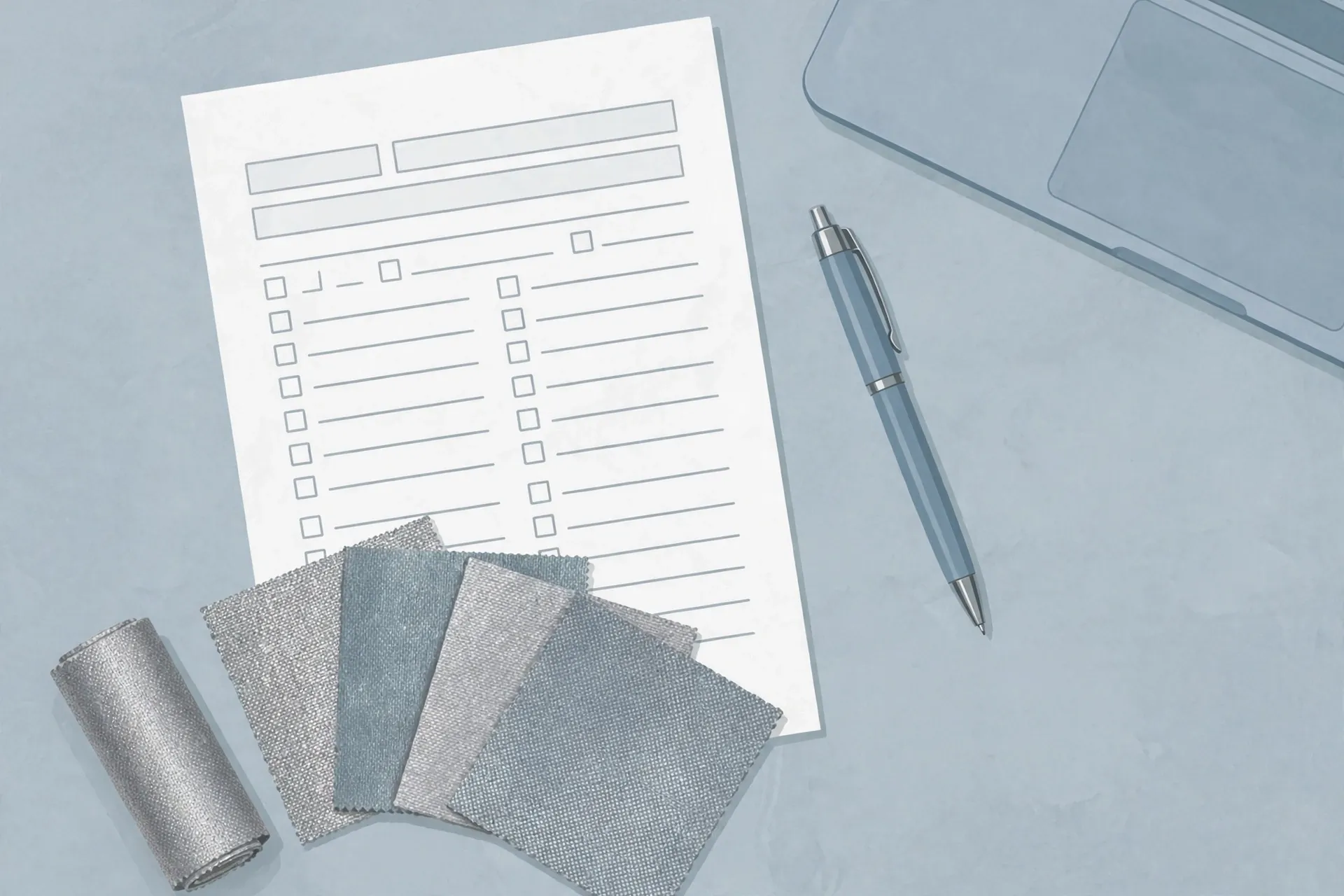
The template below is built to answer those questions in one page. It is short on purpose: a supplier should be able to read it in a few minutes and reply with a price, a sample time and a list of anything still missing.
The one-page RFQ template
Copy the headings below, fill in what is known, and leave what is not known blank rather than guessing. A blank line with a question mark is more useful than a guessed number.
1. Buyer and product
- Buyer name, contact name and email.
- What the fabric is for: the finished product, who will use it, and how it will be used — worn, hung, sewn into a bag, bonded into an assembly.
- Whether this is a first order, a repeat order, or a sample for a new product.
2. Fabric
- Fabric family: silver fibre or copper-nickel, and the surface version if known — plain, patterned, or black-coated.
- Shielding figure needed, and the test method it should be measured by, where the product depends on shielding.
- Colour, hand feel and wash requirements, where they matter to the product.
3. Size and quantity
- Width and weight needed, and how each will be measured.
- Roll length, and whether the order is for full rolls or cut lengths.
- Quantity for the first order, and the expected quantity for repeat orders, so the supplier can price both.
- Tolerance the buyer will accept on width and weight.
4. Sample
- Whether a stock sample or a custom sample is needed. A stock sample usually ships in 1 to 5 days; a custom sample usually takes 5 to 30 days depending on the process, and the exact time is confirmed once the specification is confirmed.
- What the sample will be checked against, and whether it will be cut, bonded, sewn or washed before approval.
5. Inspection and documents
- How the order will be inspected — for example, an AQL inspection of the lot before shipment — and who will inspect it.
- Documents needed with the order: test report, packing list, and any supplier certificates. Test reports and supplier certificates are available on request.
6. Packaging and delivery
- How the goods should be packed: rolls or cartons, moisture protection, and marking on each roll and carton.
- Delivery address, and how the goods will travel and be stored.
- Target delivery date, if there is one, and whether it is fixed or flexible.
7. Payment and next step
- Payment method — letter of credit, telegraphic transfer, PayPal or Western Union — and currency.
- What the buyer wants back: fabric proposal, sample time, price for the exact specification, and what is included in the sample price.
- Date by which the buyer needs the reply.
Fabric can be ordered from as little as 1 square metre, with 10 square metres or 10 metres as the suggested starting quantity, and a better price for a larger quantity. Saying the quantity — even as a range — lets the supplier price the order it is being asked for.
Common mistakes in a first RFQ
The most common mistake is asking for a price without a specification. "Shielding fabric, best price" cannot be answered, because the price depends on the fabric family, the width, the weight and the quantity. The second mistake is the opposite: a specification so long that it describes the supplier's process instead of the buyer's product. A brief should describe what the fabric must do, not how it must be made.
Other mistakes are smaller but just as costly. Naming a quantity without a unit — metres or square metres — when silver fibre is priced by the square metre and copper-nickel by the metre. Asking for a shielding figure without naming the test method, so two suppliers quote figures measured in different ways. Forgetting the tolerance, so a roll a little short of the width becomes a dispute at delivery. Forgetting the sample, so the first bulk order is also the first time the fabric is seen. And forgetting to say what the fabric is for, so the supplier cannot warn that it will not survive the product's washing, cutting or bonding.
Send the same brief to each supplier being compared, and compare the replies line by line: fabric, specification, sample time, price, documents and payment. A reply that is cheaper because it quotes a different fabric, a shorter roll, or no test report is not a cheaper quote. A reply that asks one or two sharp questions about the use is often the reply worth following up.
What a good supplier reply should include
A supplier that has understood the brief should reply with the fabric it proposes and why, the price for the exact specification, the sample time and what the sample price includes, the documents that will come with the order, and anything in the brief it cannot meet — with what it can offer instead. It should also say what it still needs from the buyer, rather than guessing. If the brief asked for a custom width or weight, the reply should confirm the width, the weight and the tolerance, and that the shielding figure will be measured on the custom fabric.
Keep the reply with the brief. When the sample arrives, check it against the brief, not the standard roll: measure the width at several points, check the weight the way the brief says it will be checked, process the sample the way production will, and approve it in writing before bulk. A brief, a reply and an approved sample are the three documents a first order rests on.
Frequently asked questions
What should an RFQ for shielding fabric include?
The buyer and the product, the fabric family and shielding figure, the width, weight, roll length and quantity, the sample needed, the inspection and documents, the packaging and delivery, and the payment method and currency.
How long should an RFQ be?
One page is enough. It should be short enough for the supplier to read in a few minutes and reply with a price, a sample time and a list of anything still missing.
Should I name a target price?
Name the specification and the quantity, and let the supplier price the exact order. A target price without a specification cannot be compared between suppliers.
What if I do not know the width or weight I need?
Say what the fabric is for and what the finished piece must be, and ask the supplier to propose a width and a weight. Leave the line blank rather than guessing a number.
How long does a sample take?
A stock sample usually ships in 1 to 5 days. A custom sample usually takes 5 to 30 days depending on the process, and the exact time is confirmed once the specification is confirmed.
Your next step
Copy the template above and fill in what you know: the fabric family, the shielding figure and the test method, the width, weight and quantity, the sample you need, the inspection and documents, the packaging and delivery, and the payment method. Leave what you do not know blank, and ask the supplier to propose it. Zimo is a trading-and-manufacturing supplier, and the details above describe how it quotes and samples; they do not describe factory capacity or production processes, which are not published. If you are ready to start, contact us through the contact page or email info@zimo-cn.com with your one-page brief, and we will reply with a fabric proposal, a sample time and a quote.