EMF Shielding Curtains for Hotels and Offices: Measuring, Hanging and Coverage in Real Rooms
A shielding curtain only works if it covers the room. This guide covers measuring, hanging and overlap for hotels and offices — and the gaps buyers forget.
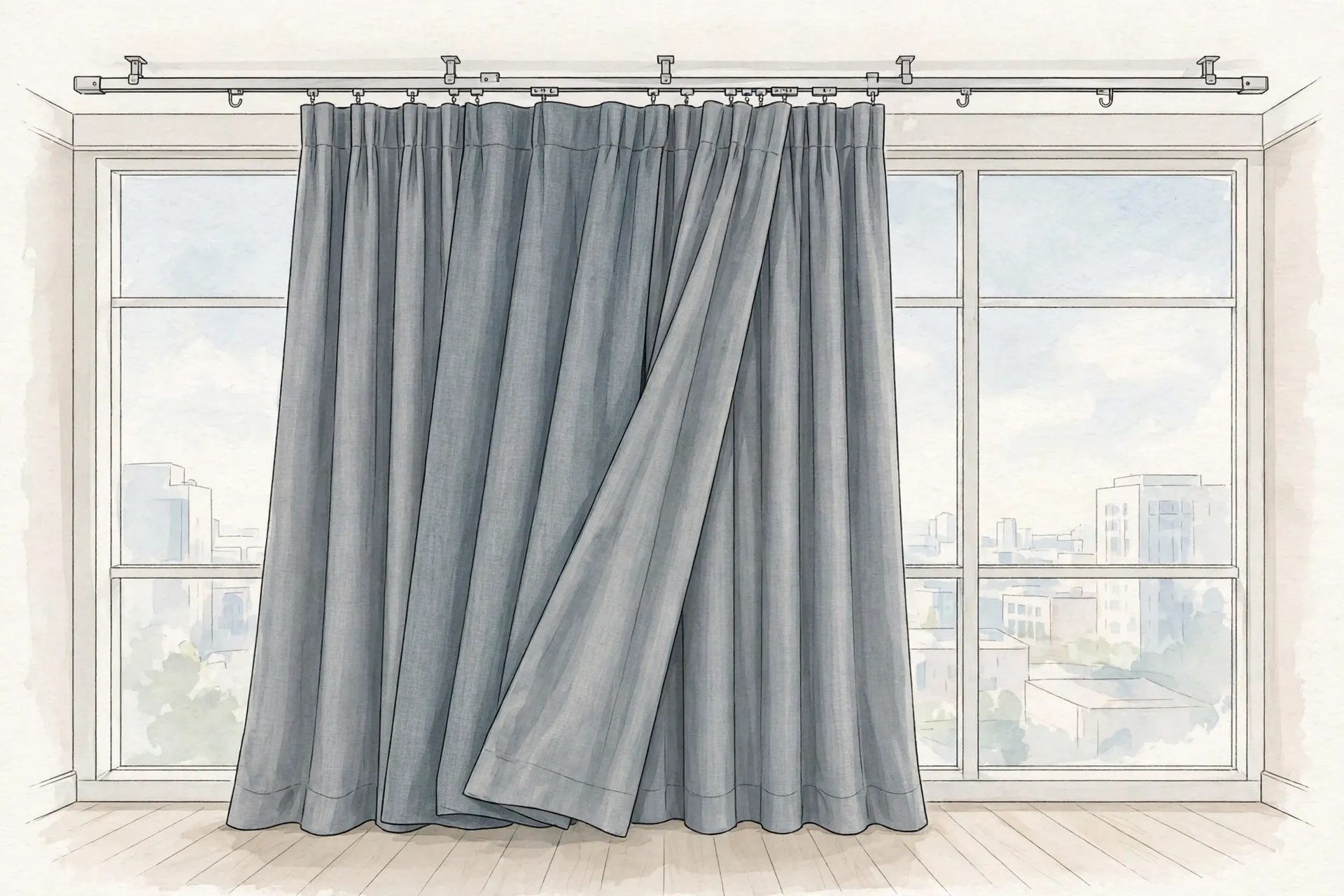
EMF Shielding Curtains for Hotels and Offices: Measuring, Hanging and Coverage in Real Rooms
A shielding curtain is not a decoration that happens to block signals. It is a piece of a room's shielding, and it only works if it covers the room. Buyers who order curtains the way they order ordinary drapes — by the window, in a colour they like, in a length that looks right — often end up with a handsome curtain and a room that is still open at the edges, at the floor, and at the joins between panels. This guide covers how hotels and offices measure, hang and check shielding curtains, so the fabric that is ordered is the fabric that covers the room.
Start with the room, not the window
The first mistake is to measure the window. A shielding curtain has to cover the opening it is meant to shield, and that opening is usually larger than the glass. Measure the full width of the wall or the recess the curtain will cover, from one side to the other, and measure the full drop from the track or rail to the floor. Then walk the room and note everything the curtain has to work around: radiators, air-conditioning units, light switches, skirting boards, door frames, and any equipment that sits against the wall. A curtain that cannot hang straight because something is in the way is a curtain with a gap, and a gap is where the shielding fails.
Decide before ordering what the curtain is for. A hotel bedroom curtain is usually there to cover the window wall, and the guest will open and close it every day. An office curtain may cover a whole glass wall, a meeting-room partition, or a server-room doorway, and it may stay closed for weeks. The use decides the fabric, the hanging and the cleaning plan, so say it in the first message: which room, which wall, how often the curtain moves, and whether it will be opened and closed daily or left in place.
Measuring: overlap, drop and fullness
Measure twice, and measure in the room, not from a plan. Plans are wrong about skirting, about radiators, and about where the track can actually be fixed. Take the width at the track, at the middle of the drop, and at the floor, because walls are rarely straight, and order to the largest of the three. Take the drop from the track to the floor at both ends and in the middle, for the same reason. Write all six numbers down, and send them with the order, so the supplier cuts to the room rather than to a single figure.
Overlap is the part buyers forget. Two curtain panels that meet in the middle need to overlap, not just touch, because a join that only touches opens every time the curtain moves or the air moves. Panels that run along a wall need to return to the wall at the sides, and a curtain that stops short of the floor leaves a gap at the bottom. Allow extra fabric for the gather, so the curtain hangs in folds rather than pulled flat: a flat curtain is a curtain that has been cut too small, and it will pull open at the joins. The supplier can advise how much extra the fabric and the heading need, but only if the room measurements and the heading type are given first.
Ask for the roll width in writing before the order is placed, because the width decides how many drops each panel needs and where the seams fall. A seam is a join, and a join is a place to check: ask how seams will be made, whether they will be sewn or bonded, and whether the finished curtain will be checked as a whole. Do not assume a fabric figure measured on a flat piece of cloth describes a finished curtain with seams, a heading and a lining. Ask for the test report of the exact fabric, with the test method named and the result in writing, and agree how the finished curtain will be checked. Test reports and supplier certificates are available on request.
Hanging: tracks, weight and linings
A shielding curtain is heavier than an ordinary curtain, and the track has to carry it. Check the track, the rail, the fixings and the wall before ordering, and say what they are in the first message: a track that holds a light voile will not hold a lined shielding curtain, and a curtain that sags pulls open at the top. If the track needs to be replaced, that is a decision for the fit-out team, not a surprise for the installer on the day.
Most hotel and office curtains are made with the shielding fabric as a lining behind a decorative face fabric, rather than as the visible curtain. Copper-nickel fabric, listed at 60 to 90 decibels, is the usual choice for linings, enclosures and curtains, because it is flexible and carries a high shielding figure; silver fibre fabric, listed at 50 to 80 decibels, is the softer choice, used where drape and hand feel matter more. Which one suits the room depends on how the curtain hangs, how often it moves, and what the guest or the office worker touches. Say which face fabric will be used, if one is already chosen, because the weight and the drape of the pair decide the heading and the track together.
The heading matters more than it looks. A heading that gathers the fabric tightly needs more fabric and a stronger track; a flat heading needs less of both but covers less when the curtain is drawn. Agree the heading with the supplier before the fabric is cut, and ask for a sample of the heading on the finished fabric, so the way the curtain hangs can be seen before the bulk order is made.
Coverage: the gaps buyers forget
Coverage is decided by the gaps, not by the fabric. Walk the finished room and check five places: the join between panels, the sides where the curtain meets the wall, the top where the curtain meets the track, the bottom where it meets the floor, and any place where a cable, a pipe or a fitting passes behind the curtain. Each one is a place where shielding can leak, and each one has a practical fix — an overlap, a return to the wall, a pelmet, a longer drop, a rearranged fitting — but only if it is found before the curtain is hung, not after the room is handed over.
For hotels, the check should be done the way a guest will use the room: open the curtain, close it, open it again, and check that it still meets in the middle and still reaches the floor. A curtain that covers the wall when it is first hung and leaves a gap after a week of use was cut too tight. For offices, the check should include the way the room is actually used: doors opened, partitions moved, equipment rolled in and out. A curtain that works when the room is empty and fails when it is in use was measured for the empty room.
Cleaning is part of coverage too. Agree the cleaning method before ordering — the temperature, the detergent type, the cycle, and whether the curtain is machine washed, hand washed or dry cleaned — and agree how the curtain will be tested after cleaning. Do not accept a wash count from a brochure: how many washes a curtain survives depends on the fibre, the blend, the construction and the washing method together. Ask for the test plan, not a number.
Ordering: samples, quantities and what to check
Fabric can be ordered from as little as 1 square metre, and the suggested starting quantity is 10 square metres or 10 metres, with a better price for a larger quantity. Silver fibre fabric is usually priced by the square metre, while copper-nickel fabric is usually priced by the metre. For curtains, order by the drop: give the number of panels, the width and the drop of each one, the heading type, and whether the shielding fabric is the curtain or a lining behind a face fabric, because the price depends on all of it.
A stock sample usually ships in 1 to 5 days, while a custom sample usually takes 5 to 30 days depending on the process, and the exact time is confirmed once the specification is confirmed. Order the sample in the exact fabric you will buy, hang it the way the finished curtain will hang, and check the drape, the weight, the seams and the hand feel before you approve bulk. When the finished curtains arrive, check each panel against the measurements, check the seams and the heading, and hang one panel and open and close it before the rest are hung, so a cutting mistake is found on one panel rather than on the whole room.
Payment is by letter of credit, telegraphic transfer, PayPal or Western Union. Confirm the method and the currency before the order is placed. Yiwu Zimo Trading Company is a trading-and-manufacturing supplier. The details above describe how it quotes and samples; they do not describe factory capacity or production processes, which are not published, and they do not promise a shielding level for a room that has not been measured and checked as installed.
Frequently asked questions
Which fabric is used for shielding curtains?
Copper-nickel fabric, listed at 60 to 90 decibels, is the usual choice for curtain linings. Silver fibre fabric, listed at 50 to 80 decibels, is the softer choice where drape and hand feel matter more.
How do we measure for a shielding curtain?
Measure the full width and the full drop in the room, at several points, and send all the numbers. Allow for overlap between panels, returns to the wall at the sides, and a drop that reaches the floor.
What matters more, the fabric or the gaps?
Both, but the gaps decide the result. A curtain with a good fabric and an open join, a short drop or a gap at the sides does not cover the room.
Can the shielding fabric be a lining?
Yes. Most hotel and office curtains use the shielding fabric as a lining behind a decorative face fabric. Say which face fabric will be used, so the weight, the drape and the heading can be planned together.
How long does a sample take?
A stock sample usually ships in 1 to 5 days. A custom sample usually takes 5 to 30 days depending on the process, and the exact time is confirmed once the specification is confirmed.
Your next step
Write a one-page brief with the room and the wall the curtain will cover, the width and the drop measured in the room, the heading type, whether the shielding fabric is the curtain or a lining, how often the curtain will move, the cleaning method, the quantity, the documents you need, and the payment method and currency. Send it and ask the supplier to confirm the fabric, the roll width, the sample time, the test that will be run on the sample, and what is included in the sample price. When the sample arrives, hang it and open and close it before you approve bulk. If you are ready to start, contact us through the contact page or email info@zimo-cn.com with your brief, and we will reply with a fabric proposal, a sample time and a quote.