Sep 8, 2026Company News & Updates
What Is Electromagnetic Radiation? | EMF Explained
Learn what electromagnetic radiation is, how frequency and energy are related, the difference between ionizing and non-ionizing radiation, and where EMF is found in everyday life.
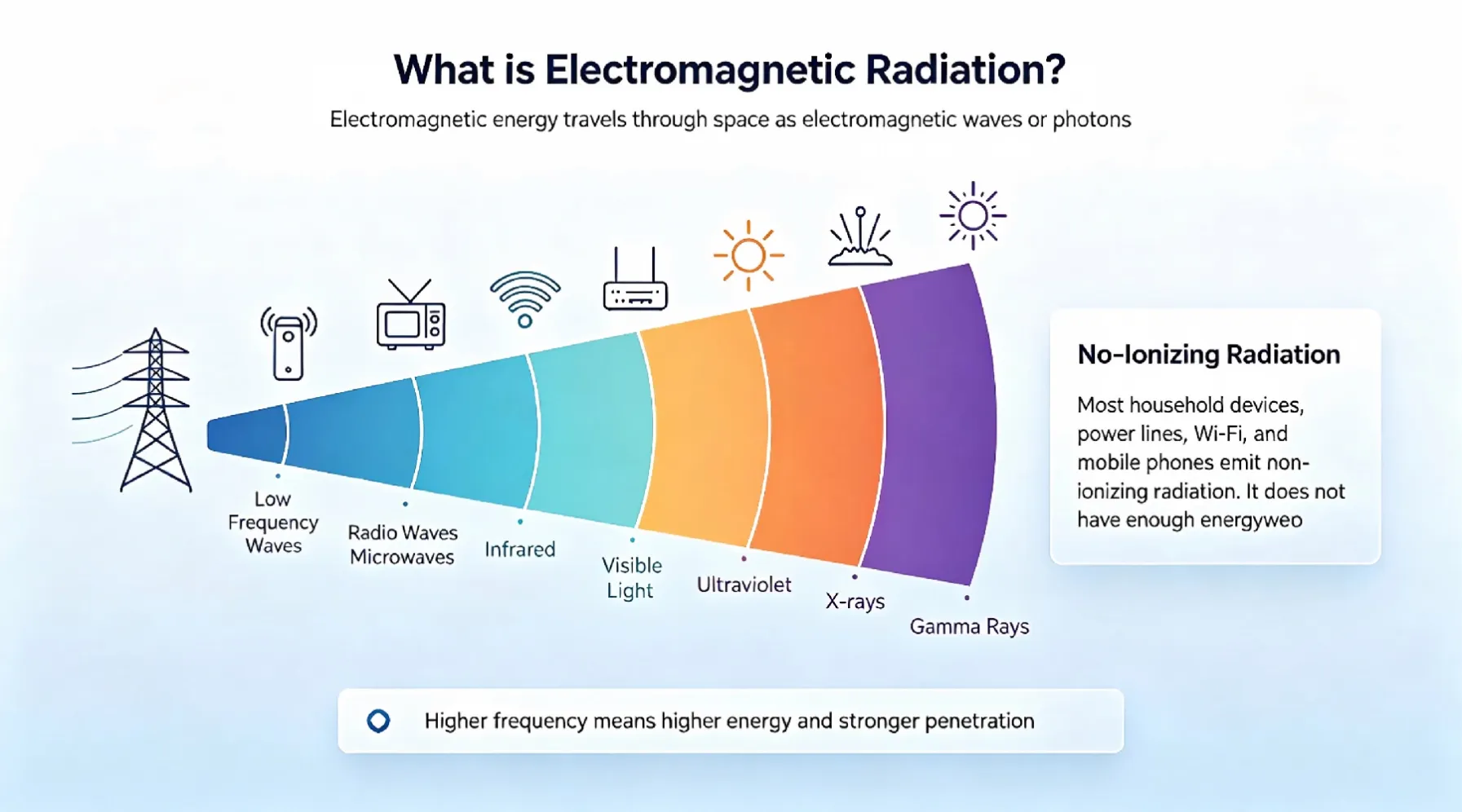
Electromagnetic radiation is energy that travels through space as oscillating electric and magnetic fields. In quantum physics, the same energy is described as packets called photons. Electromagnetic radiation is part of everyday life: sunlight, radio and television signals, Wi-Fi, mobile communications, infrared heat, and medical X-rays all belong to the electromagnetic spectrum.
The term electromagnetic radiation does not automatically mean something is dangerous. Its properties depend on factors such as frequency, intensity, distance from the source, exposure time, and whether the radiation is ionizing or non-ionizing.
The Electromagnetic Spectrum
The electromagnetic spectrum includes a continuous range of frequencies. Frequency describes how many times a wave oscillates per second and is measured in hertz (Hz). As frequency increases, the energy of each photon also increases.
From lower to higher frequency, the spectrum generally includes:
Type of electromagnetic radiation | Common examples |
Extremely low-frequency fields | Power lines, electrical wiring, transformers, and household appliances |
Radio waves | Radio and television broadcasting, two-way radios, and wireless communications |
Microwaves | Mobile phones, cellular base stations, Wi-Fi routers, radar, and microwave ovens |
Infrared radiation | Heat from people and objects, remote controls, heaters, and thermal cameras |
Visible light | Sunlight, LEDs, fluorescent lamps, and other lighting |
Ultraviolet radiation | Sunlight, tanning equipment, and some disinfection devices |
X-rays | Medical imaging and industrial inspection equipment |
Gamma rays | Radioactive decay and certain medical and space-related processes |
The boundaries between these categories are not always identical across scientific or regulatory sources. They are useful descriptions of ranges within one continuous spectrum rather than completely separate types of energy.
Ionizing vs. Non-Ionizing Radiation
One of the most important distinctions is whether radiation has enough energy to remove electrons from atoms or molecules. This process is called ionization.
Non-ionizing radiation
Non-ionizing radiation does not normally have enough energy per photon to ionize atoms. It includes extremely low-frequency fields, radio waves, microwaves, infrared radiation, and visible light. Depending on the frequency and intensity, non-ionizing radiation can produce effects such as electrical stimulation, heating, or chemical and biological responses.
The radiofrequency signals used by mobile phones, Wi-Fi routers, Bluetooth devices, and many communication systems are generally classified as non-ionizing radiation. A compliant microwave oven also uses non-ionizing microwave energy. It is designed with shielding, door interlocks, and leakage limits to help prevent hazardous exposure during normal use.1 2
Ionizing radiation
Ionizing radiation has enough energy to remove electrons from atoms or molecules. It includes higher-energy ultraviolet radiation, X-rays, and gamma rays. At sufficient levels, ionizing radiation can damage biological tissue and DNA, which is why it is carefully controlled in medical, industrial, and research settings.2
The division between ionizing and non-ionizing radiation is based primarily on photon energy, not simply on whether a device is electrical or wireless. For this reason, it is inaccurate to describe all electromagnetic radiation as equally harmful.
Does Every Electrical Device Produce Electromagnetic Radiation?
Electrical devices can produce electric and magnetic fields when they contain voltage, current, or changing electrical signals. However, a static electric or magnetic field is not the same as electromagnetic radiation traveling away from a source.
Radiation is produced when changing electric and magnetic fields propagate through space. The amount and type of electromagnetic energy emitted depend on the device’s design, operating frequency, power, distance, and surrounding materials.
For example, power equipment and household appliances can produce low-frequency fields, while phones, wireless routers, and radio transmitters operate at higher radiofrequencies. The presence of an electromagnetic field alone does not indicate that an exposure is unsafe. Exposure assessment requires measurements and comparison with applicable safety limits.
Common Sources of Electromagnetic Radiation at Home and Work
People encounter electromagnetic fields from both natural and manufactured sources. Natural sources include sunlight, the Earth’s magnetic field, lightning, and heat emitted by objects. Human-made sources include power systems, lighting, communications equipment, medical devices, industrial equipment, and household appliances.
The following examples are commonly discussed in relation to everyday EMF exposure:
- Power lines and electrical systems: These are associated mainly with low-frequency electric and magnetic fields.
- Mobile phones and cellular base stations: These use radiofrequency electromagnetic energy to transmit information.
- Wi-Fi routers and Bluetooth devices: These use low-power radiofrequency signals for wireless communication.
- Microwave ovens: These use microwave energy to heat food. A properly maintained oven that meets applicable standards is designed to contain the energy during operation.1
- Lighting and sunlight: Visible and infrared radiation are present in ordinary lighting and sunlight. Sunlight also contains ultraviolet radiation, which requires appropriate protection.
- Medical imaging equipment: X-ray systems use ionizing radiation and are operated under specific medical and safety procedures.
What Determines Exposure?
The word “exposure” describes the amount of electromagnetic energy that reaches a person or object. It is influenced by several factors:
- Frequency: Frequency affects how electromagnetic energy interacts with matter.
- Power or field strength: A stronger source can produce a higher exposure near the source.
- Distance: Exposure often decreases as distance from the source increases, although the exact relationship depends on the source and environment.
- Duration: Longer exposure can increase the total amount of energy absorbed or received.
- Shielding and surroundings: Walls, enclosures, building materials, and device design can affect field distribution.
- Operating conditions: A device may emit different levels depending on whether it is idle, transmitting, charging, heating, or operating under load.
For this reason, it is not scientifically meaningful to judge a product or device solely by its name. A meaningful evaluation should consider the type of field, the measured level, the distance, the exposure conditions, and the relevant standard or guideline.
How Can People Reduce Unnecessary EMF Exposure?
For people who prefer to reduce unnecessary exposure from radiofrequency or low-frequency sources, simple distance and use-based measures are generally more practical than fear-based claims. For example, users can keep a transmitting device away from the body when convenient, avoid using damaged electrical equipment, follow manufacturer instructions, and maintain appliances in good condition.
For microwave ovens, do not use the appliance if the door, hinges, latch, or seals are damaged, or if it continues operating with the door open. Follow the manufacturer’s instructions and contact the manufacturer or a qualified service provider if a safety problem is suspected.1
Protective products should be evaluated carefully. A product should state which frequency range it is designed for, explain how performance was tested, identify the measurement method, and avoid implying that it can block every type of electromagnetic field. No single material or product can automatically protect against the entire electromagnetic spectrum.
Frequently Asked Questions
Is electromagnetic radiation the same as nuclear radiation?
No. Electromagnetic radiation is energy carried by electromagnetic waves or photons. Nuclear radiation commonly refers to radiation released by unstable atomic nuclei, such as alpha particles, beta particles, or gamma rays. Gamma rays are electromagnetic radiation, but not all electromagnetic radiation comes from nuclear processes.
Is Wi-Fi radiation ionizing?
Wi-Fi uses radiofrequency electromagnetic radiation, which is generally classified as non-ionizing. It does not have enough photon energy to directly ionize atoms in the way X-rays and gamma rays can. The relevant safety question still depends on exposure level and applicable limits, not simply on the word “radiation.”
Is visible light electromagnetic radiation?
Yes. Visible light is one portion of the electromagnetic spectrum. Infrared radiation, ultraviolet radiation, radio waves, microwaves, X-rays, and gamma rays are also parts of the same spectrum.
Does higher frequency always mean greater danger?
Higher frequency means higher energy per photon, but danger depends on more than frequency. Intensity, exposure duration, distance, absorption, and the biological effect of the radiation are also important. A high-frequency source and a low-frequency source should not be compared without considering the actual exposure conditions.
Can electromagnetic radiation be completely blocked?
There is no universal shield that blocks every type of electromagnetic radiation. Effective shielding depends on the frequency, field type, source strength, material, thickness, construction, and whether openings or seams are present. Product claims should therefore be supported by frequency-specific test data rather than general statements such as “blocks all radiation.”
Key Takeaway
Electromagnetic radiation is a broad category of energy that includes everything from low-frequency fields and radio waves to visible light, X-rays, and gamma rays. The most useful way to understand it is to consider the frequency, energy, source, exposure level, distance, and duration—not to treat every form of radiation as identical.
For consumer decisions, choose products and devices that comply with applicable standards, use equipment according to the manufacturer’s instructions, and be cautious of products that make absolute health or “total protection” claims without transparent, independent testing.