Oct 3, 2026Guides & Education
How Shielding Effectiveness Is Measured: dB, Bands and Reports
Shielding effectiveness testing explained: dB vs frequency bands, how to read an EMF fabric test report, ASTM D4935 basics, and supplier red flags.
Every EMF shielding product is sold on numbers: 60 dB, 80 dB, 99.99% reduced. But a figure without context — which frequency, which method, who measured it — says little about how a fabric performs in your application. This guide explains shielding effectiveness testing at a practical level: what the dB scale means, how laboratories measure fabrics, how to read a test report, and which supplier claims deserve a second question. It is written for sourcing teams, manufacturers and informed consumers.
What Shielding Effectiveness Actually Means
Asked simply, how is EMF shielding measured? A material's shielding effectiveness (SE) describes how much it weakens a signal at a specific frequency: the ratio between the signal measured without the shield and the signal measured with it, expressed in decibels (dB) on a logarithmic scale: SE (dB) = 20 × log₁₀ (signal without shield ÷ signal with shield).
Because the scale is logarithmic, moderate dB figures represent large signal reductions:
Shielding effectiveness | Approximate signal reduction
10 dB | ≈ 90%
20 dB | ≈ 99%
30 dB | ≈ 99.9%
40 dB | ≈ 99.99%
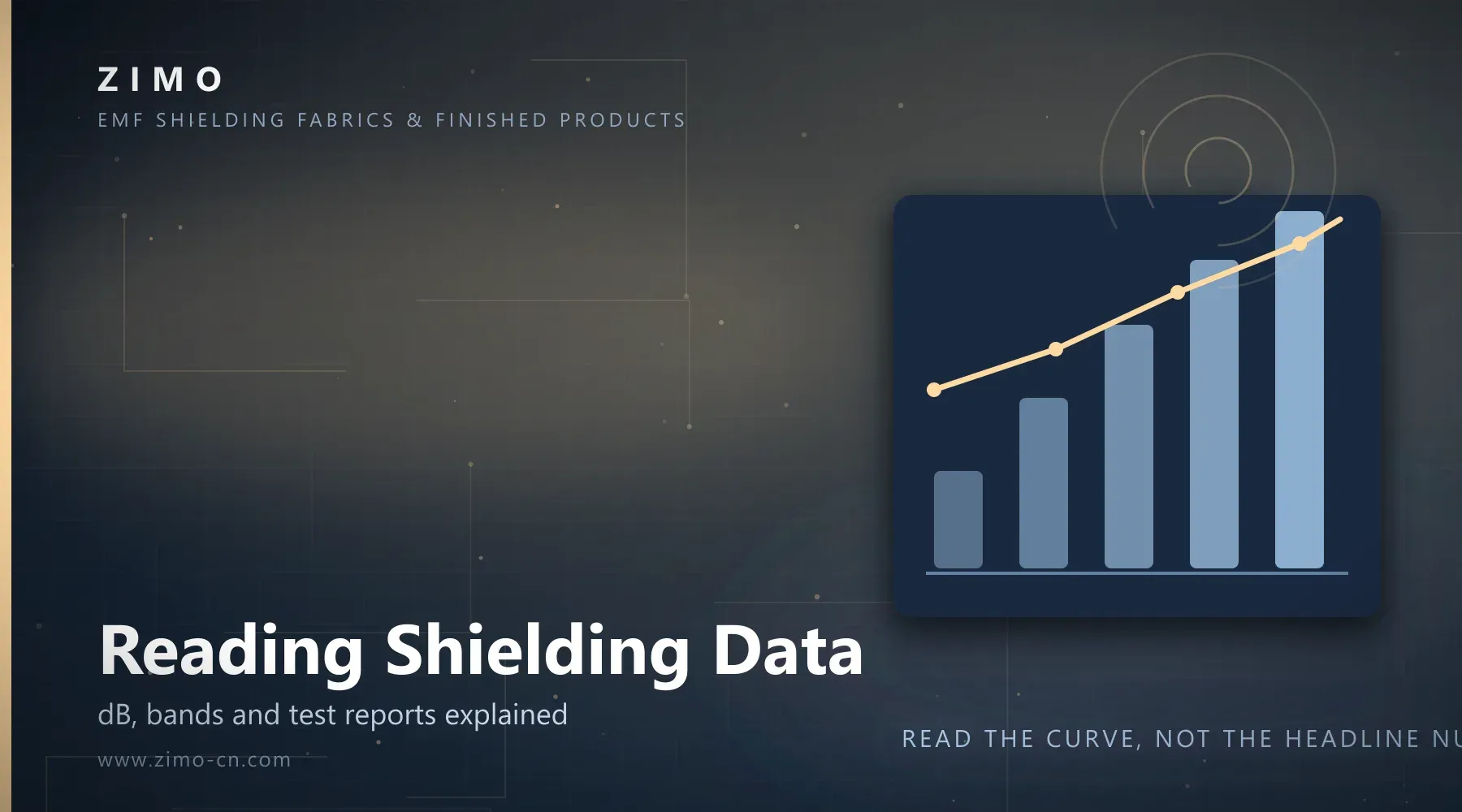
The key point: shielding effectiveness is a curve across frequencies, not a single number. A fabric that measures 70 dB at one frequency may read lower at another. A single dB figure is one point on that curve, and a serious specification tells you where on the curve the number was taken.
How Laboratories Measure Shielding Fabrics
Planar material methods
For flat textiles and sheets, the most commonly referenced approach is a standardized planar-material method — ASTM D4935 is the name most often cited for measuring the shielding effectiveness of planar materials such as fabrics. Fixture setup, sample preparation and the frequency range covered vary from laboratory to laboratory, so ask which method and range a specific report used rather than assuming all standard-named figures are directly comparable.
Chamber and finished-product testing
Once a fabric becomes a garment, a canopy or an enclosure, the measurement question changes. Finished products and assemblies are typically evaluated with chamber-based or enclosure-based setups that approximate real use, and those figures are not directly comparable to flat-material data. The safe approach stays high level: ask what was tested — material or product — and how.
Why Frequency Bands Change the Conclusion
How a signal interacts with a fabric depends on its wavelength relative to the material's structure — fibre density, coating and, for mesh materials, aperture size all behave differently across frequencies. The same fabric can therefore show meaningfully different readings at, for example, 900 MHz and 2.4 GHz; gaps of several dB between bands are normal.
In dB attenuation testing, the band is part of the result, not an optional detail. A highest-dB figure quoted without a frequency band is a marketing number, not a specification. "At which frequency?" should be the first question you ask — and the first a trustworthy supplier answers voluntarily.
How to Read an EMF Fabric Test Report
A usable EMF fabric test report has four components. Check each before relying on the data:
Frequency points. Which frequencies or bands were measured? A report listing values across a range is far more informative than a single figure.
The curve, not the peak. Look at how dB values move across the frequency list. A stable curve is usually more useful in practice than one dramatic peak.
Sample correspondence. The report should identify the exact material tested — type, weight, coating and layer count. Data is valid only for that spec; a similar-looking fabric is not the same fabric.
Test context. Who performed the test, what method was used, and when. Manufacturer self-testing is legitimate when labelled honestly; third-party testing is a stronger signal when the report itself is available.
If a supplier cannot connect a quoted number to a report with these four elements, treat the figure as unverified.
Five Red Flags When Comparing Suppliers
One headline value only. "Up to 100 dB" with no band attached is a selection, not a specification.
No attribution. The claim does not say whether the figure is manufacturer-tested or independently tested.
No frequency information. A dB figure without a band reference cannot be compared against other quotes.
Spec and data do not match. The report describes a different weight, coating or layer count than the fabric being quoted.
Reports refused. Data can exist internally and still not be shared; willingness to provide the report behind a figure is itself a quality signal.
None of these flags proves a product is poor — they mean you are being asked to buy on trust where data was possible.
How Zimo Reports Shielding Data
Zimo states shielding values as manufacturer-tested ranges per defined specification, not as single peak numbers, because the same spec performs differently across frequencies:
Material | Manufacturer-tested shielding range*
Copper Nickel Fabric | 60–90 dB
Silver Fiber Fabric (dense grades) | 50–80 dB
Silver Fiber Mesh (canopy and mosquito-net grades) | approx. 20–40 dB
*Manufacturer-tested values for defined specs; actual performance varies with frequency and specification. Test reports are available on request for selected specs.
Two points of honesty. First, these are manufacturer-tested values: Zimo does not present them as third-party certification. Where reports exist for a spec, they are available on request. Second, the ranges are deliberately wide, reflecting variation across frequencies and specs. Dense silver fiber fabric sits at the higher end; open silver fiber mesh, chosen for breathability in canopies and bed enclosures, sits lower — plus silver fiber offers softness and natural antimicrobial properties, relevant for wearables. Which trade-off fits your product is an application question, not a dB question.
Beyond these families, other conductive fabrics are available on request — contact us for specs rather than assuming parameters.
Ask for the Test Data Behind Any Spec
Ask for the test data behind any spec — request a sample and reports. Zimo supplies manufacturer-tested shielding fabrics and finished EMF protection products to brands, manufacturers and consumers worldwide. Standard items carry no MOQ; custom sizes, weights and styles are supported for OEM/ODM orders.
Frequently Asked Questions
Can I test EMF fabric with a home EMF meter?
Consumer meters measure field strength in your surroundings, not a material's shielding effectiveness, and they are easy to misread. Holding fabric in front of a meter may lower the reading, but without a controlled signal, fixed distance and consistent orientation the result is anecdotal. Use a home meter for orientation, not for comparing specs; rely on documented data for sourcing decisions.
What three questions should I ask a supplier before ordering?
First, at which frequencies was the figure measured? Second, who measured it — manufacturer or third party — and can you provide the report for this exact spec? Third, does the tested sample match the quoted spec in weight, coating and layers? A supplier who answers all three promptly is demonstrating the transparency this article describes.
Why do shielding numbers differ so much between suppliers?
Three reasons: different specs (a dense weave and an open mesh are different materials), different methods and laboratories, and different frequency bands. A 70 dB claim and a 40 dB claim can both be accurate — for different materials at different frequencies. Ranges plus bands tell you more than single numbers.
Is higher dB attenuation always better?
No. Shielding is one property among several. Higher attenuation often trades against weight, breathability, flexibility or cost. A 90 dB fabric is not "better" than a 50 dB fabric if your application needs a breathable wearable; for a fixed panel the calculation may reverse. Match the material to the application first, then compare data within that shortlist.
Why do finished products perform differently from fabric data?
Fabric data describes material in a test fixture. A finished hat, blanket or canopy adds coverage, seams and layering, and openings or joins are usually the limiting factor, not the fabric itself. Treat product-level and fabric-level figures as related but distinct, and ask which one a claim refers to.
Related Reading
EMF Shielding Fabric Guide — how fabric types, shielding ranges and applications compare.
Copper Nickel Fabric — specs and manufacturer-tested shielding ranges for the copper nickel family.
RFID Blocking Fabric for Wallets — where conductive textiles meet everyday carry protection.