Guides & Education
EMF Shielding Fabric for Electric Vehicle Interiors: Where Buyers Use It and What They Test
Electric vehicle interiors put shielding fabric where passengers sit, cables run and electronics live. This guide covers the main uses, what buyers test, and how to brief a supplier.
EMF Shielding Fabric for Electric Vehicle Interiors: Where Buyers Use It and What They Test
An electric vehicle carries more electronics, more cabling and more high-power components than the car it replaces, and the interior is where all of that sits closest to the people inside. Shielding fabric is one of the materials buyers use to manage that, and it shows up in places a first-time buyer does not always expect: behind a trim panel, inside a seat, around a cable, under a headliner. This guide is for a Tier supplier, an interior trim buyer or a product manager who is sourcing shielding fabric for an electric vehicle interior for the first time. It covers where the fabric is used, what buyers test, and how to brief a supplier so the first sample answers the right questions. It is not an automotive engineering guide: the specification and the test requirements come from your customer, and the supplier's job is to meet the brief you send, not to set the standard.
Where shielding fabric is used inside an electric vehicle
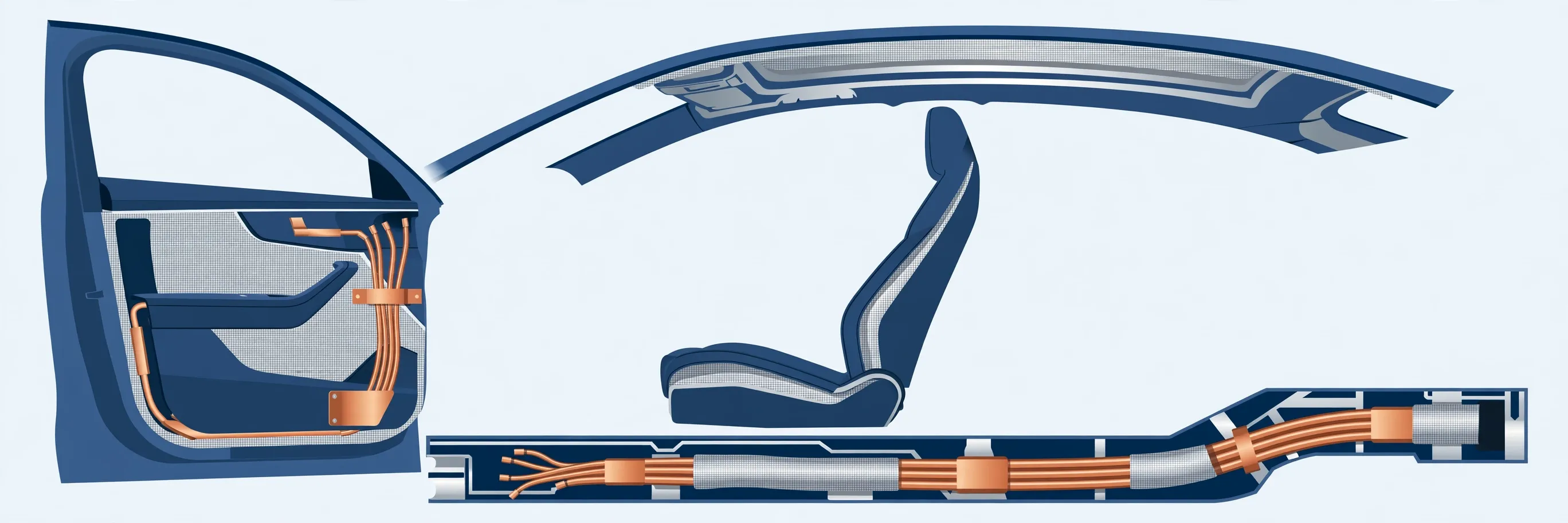
The first use is cable and component shielding: wraps around cable bundles, covers for electronic modules, and linings inside housings and enclosures. Here the fabric is cut to shape and bonded or sewn, and the questions are about flexibility, thickness, and whether the shielding holds at a fold, a bend or a seam. The second use is interior trim: linings behind door panels, under headliners and inside seat structures, where the fabric is hidden but has to survive the life of the vehicle. Here the questions are about durability, weight, and whether the fabric can be laminated or bonded to the trim material your line already uses. The third use is seating and soft trim: seat liners, covers and inserts where the fabric is close to the passenger and has to feel right as well as shield. Here the questions are about hand feel, breathability and how the fabric behaves after repeated use. The fourth use is gaskets and seals: conductive foam and fabric around enclosures, doors and access panels, where the seal is the shielding. Here the material has to compress, recover and keep contact over time.
A buyer who names the use in the first message saves a round of questions. A cable wrap and a seat liner are not the same order, even if they use the same roll of fabric, because one is cut to shape and the other is laminated, one is measured in cut pieces and the other in square metres, and the test each one needs is different.
Choosing the material
Copper-nickel fabric is listed at 60 to 90 decibels in the product guides on this site, and it is the usual choice for cable wraps, linings and trim, because it is flexible, light and easy to cut, bond and sew. Conductive foam, used for gaskets and seals around enclosures and access panels, is listed above 75 decibels. Silver fibre fabric is listed at 50 to 80 decibels, and it is the usual choice where a softer hand feel or a textile finish matters, for example in seat liners and soft trim that passengers touch. Those ranges are a starting point for discussion, not a promise for your finished part, because the shielding a part reaches depends on the shape, the seams, the bonding and the closures as well as the roll of fabric. Name the shielding target and the test you want in the same message, and ask for the test result in writing, with the test method named. Test reports and supplier certificates are available on request.
When you choose, think about what the material has to survive after it is fitted. A cable wrap is folded and bent, so flexibility matters more than anything else. A trim lining is bonded to another material, so ask whether the fabric can be laminated or bonded the way your line works, and send a sample of the trim material if you can, so the supplier can test the bond rather than guess it. A seat liner is used every day, so durability and hand feel matter as much as shielding. A gasket is compressed and released, so recovery matters more than the number on the roll. Tell the supplier how the material will be fixed, joined and used, and ask which fabric and which weight they would propose for that use, rather than choosing from a name alone.
What buyers test, and what to agree before sampling
The test list for an interior part starts with shielding, and it should not end there. Agree before sampling what will be tested, on which part of the finished piece, and after what treatment, because a test result without a method is a sentence, not a specification. For a cable wrap or a lining, the shielding test should be run on the finished, joined piece, not on a flat piece of fabric, because the seams and the folds are part of the result. For a seat liner or a soft trim part, agree how the sample will be handled before the test, so the result reflects the part as it will be used. For a laminated trim piece, test the bonded part, not the fabric alone, because the bond is part of the product.
Then agree the durability checks your customer requires. Name them in the brief: the abrasion, flexing, temperature or ageing checks your customer asks for, and the pass result for each one. If your customer has a specification document, send the pages that apply to the fabric, rather than describing them in your own words, so the supplier tests against the right requirement. If your market needs a specific document, name it in the brief and ask what the supplier can provide with the sample. Do not assume a document that applies to a roll of fabric automatically applies to a finished part in your market, and do not assume a supplier's test report replaces your customer's approval. The boundary here is simple: the supplier can propose a fabric, supply a sample and report a test result. The decision about whether that result meets your customer's specification is yours and your customer's.
Samples, quantities and what to check
Fabric can be ordered from as little as 1 square metre. The suggested starting quantity is 10 square metres or 10 metres, with a better price for a larger quantity, and silver fibre fabric is usually priced by the square metre while copper-nickel fabric is usually priced by the metre. Finished products in stock can be ordered from 1 to 2 pieces, while an out-of-stock item needs a new quotation and lead time. Say whether you are ordering fabric by the roll or finished goods, give the width, and say whether the fabric will be cut, bonded or laminated, because each one changes the quantity and the sample you should ask for.
A stock sample usually ships in 1 to 5 days, while a custom sample usually takes 5 to 30 days depending on the process, and the exact time is confirmed once the specification is confirmed. Order the sample before you promise your customer a delivery date. When it arrives, check the fabric, the edges, the bond and the joins first, then run the agreed shielding and durability checks on the finished piece, and keep the result with the sample. Ask for the documents you need with the sample, not with the bulk order, so a missing document is found while the order is still small. Decide the labelling before the sample is cut if the goods carry your own brand, in the language and wording your market expects.
Payment is by letter of credit, telegraphic transfer, PayPal or Western Union. Confirm the method and the currency before the order is placed. Yiwu Zimo Trading Company is a trading-and-manufacturing supplier. The details above describe how it quotes and samples. They do not describe factory capacity or production processes, which are not published, and they do not promise a shielding level for a part that has not been tested.
Frequently asked questions
Where is shielding fabric used in an electric vehicle interior?
In cable wraps and component covers, in linings behind door panels, headliners and seat structures, in seat liners and soft trim, and in gaskets and seals around enclosures and access panels. Name your use in the first message, because the material and the test depend on it.
Which fabric should we use?
Copper-nickel fabric, listed at 60 to 90 decibels, is the usual choice for cable wraps, linings and trim. Silver fibre fabric, listed at 50 to 80 decibels, is the usual choice where a softer hand feel matters. Conductive foam, listed above 75 decibels, is used for gaskets and seals.
What should we test on the sample?
The shielding test on the finished, joined piece, and the durability checks your customer requires, agreed before sampling, with the test method named and the result in writing.
How much fabric can we order for a first test?
Fabric can be ordered from as little as 1 square metre. The suggested starting quantity is 10 square metres or 10 metres, with a better price for a larger quantity.
How long does a sample take?
A stock sample usually ships in 1 to 5 days. A custom sample usually takes 5 to 30 days depending on the process, and the exact time is confirmed once the specification is confirmed.
Your next step
Write a one-page brief with the use case, the fabric, the shielding target and the test method, how the part will be cut, bonded or laminated, the quantity in the unit the supplier prices in, the width, the durability checks your customer requires, the documents you need, and the payment method and currency. Send it and ask the supplier to confirm the fabric, the sample time, the test that will be run on the sample, and what is included in the sample price. When the sample arrives, test the finished piece before you approve bulk. If you are ready to start, contact us through the contact page or email info@zimo-cn.com with your brief, and we will reply with a fabric proposal, a sample time and a quote.