Oct 3, 2026Guides & Education
How EMF Protection Clothing Is Made: From Yarn to Garment
How is EMF protection clothing made? See how conductive yarns become shielding fabrics and finished garments — and what decides real-world performance.
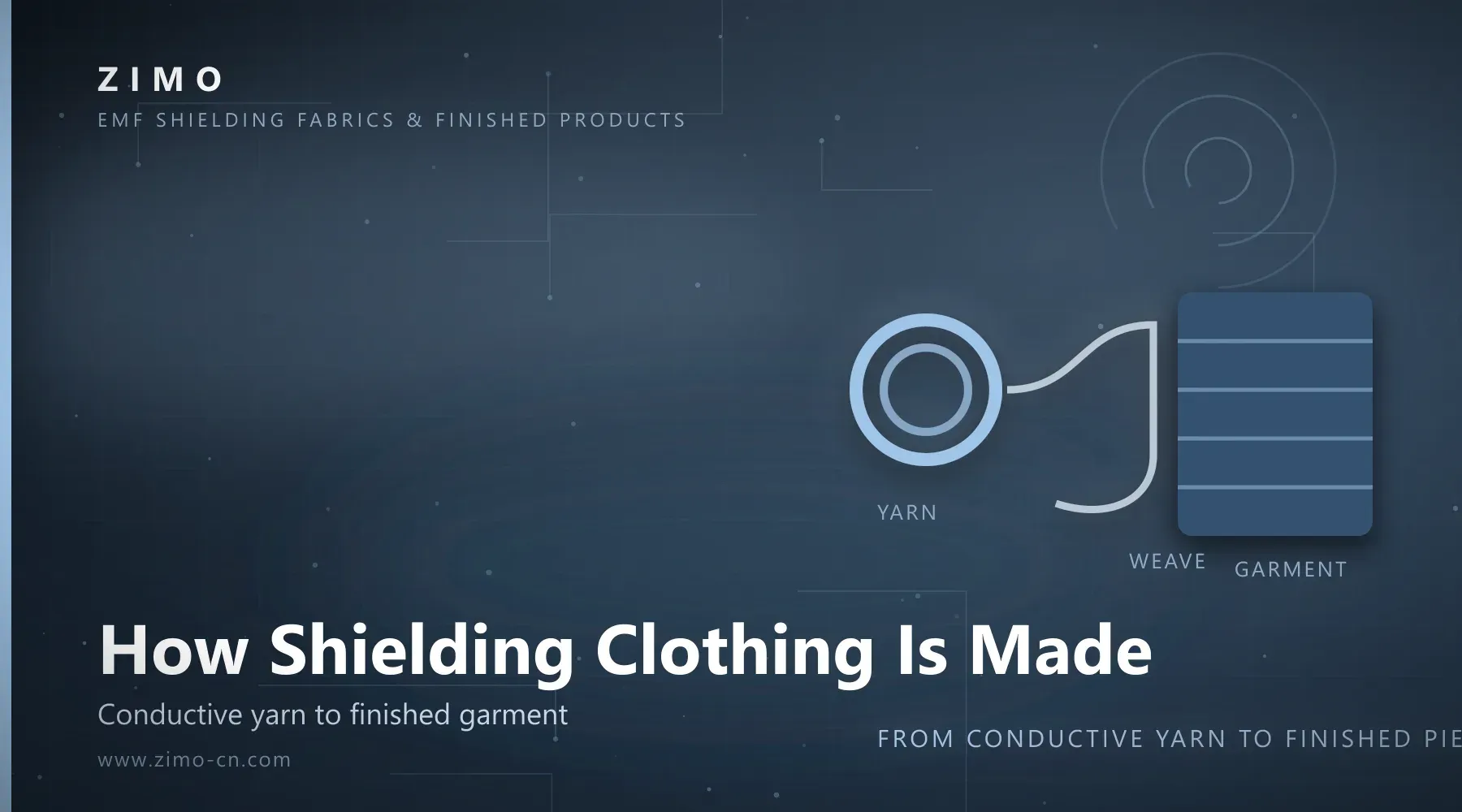
Most shoppers compare EMF protection clothing by a single number. Yet two garments with similar specs can perform very differently once cut, sewn, and worn. The reason lies in manufacturing: shielding performance is shaped at every stage — the fiber, the weave, the construction, and the quality checks behind them.
This article explains how EMF protection clothing is made, from conductive yarn to finished garment, for curious consumers and for brand founders evaluating OEM partners. The examples draw on Zimo's own production chain, where shielding fabrics and finished garments are made under one roof.
Step One: Three Common Routes to Conductive Fiber
All shielding clothing starts with the same problem: ordinary textile fibers do not interact with electromagnetic waves, so conductivity must be added. Conductive fabric production industry-wide follows three common routes.
Metal-coated fibers
The most common approach for wearables is coating a textile filament — typically nylon or polyester — with a thin metallic layer, usually silver. The resulting silver-plated yarn keeps the softness of the base textile while gaining conductivity, which is why silver fiber fabrics are widely used next to the skin: hats, blankets, underwear, and scarves. Silver fiber is also naturally antibacterial.
Metal blends and core-spun yarns
A second route mixes metal into the yarn itself — blended during spinning or spun around a textile core. The trade-off is a firmer hand feel as metal content rises, which suits durable, workwear-style garments.
Metallized fabrics
The third route applies a metallic coating — copper-nickel formulations are a typical example — to a finished fabric. This reaches high attenuation efficiently in sheet form, but because the conductive layer sits on the surface, wash and abrasion behavior deserve extra attention in garment design.
No route is universally best: each trades softness, wash durability, and cost — the first reason similar-looking products differ in real life.
Step Two: Weaving — Dense Fabric vs. Mesh
Once conductive yarn exists, the weave decides how much shielding you get — and how the fabric feels.
A dense weave puts more conductive material per square meter, so attenuation rises — but so do weight, stiffness, and cost, while breathability falls. An open mesh works the other way: air and light pass through, and attenuation comes down accordingly.
Both have legitimate uses, and Zimo weaves both. Our dense silver fiber fabric (the tightly woven specification) is manufacturer-tested at 50–80 dB, the open silver fiber mesh developed for canopies at roughly 20–40 dB, and our copper-nickel fabric — a metallized construction — at 60–90 dB. All are manufacturer-tested; test reports are available on request. Roughly converted, 20 dB ≈ 99% attenuation and 40 dB ≈ 99.99% — different scenarios, not better and worse versions of one product.
The practical point: an all-day garment cannot simply use the highest-dB sheet available — it needs a construction the wearer will actually keep on.
Step Three: From Fabric to Garment
In EMF shielding clothing manufacturing, this stage creates the widest gaps between products — and gets the least publicity.
Lined construction vs. full-shield fabric
Garment makers follow two broad strategies. A lined construction places shielding fabric as an inner layer or in key zones of an otherwise conventional garment — the crown of a cap, the front of an apron, the pocket wall of a uniform. Full-shield construction lets the conductive fabric itself form the garment surface, common in blankets, scarves, and some underwear where broad coverage is the point. Neither is automatically superior — the description should match the construction used.
Seams and openings decide the outcome
Shielding depends on continuity: the conductive material must wrap the protected area without gaps. Every seam, neckline, cuff, and closure is a potential weak point. Careful manufacturers plan seams so conductive layers stay in contact across panels, finish edges at openings deliberately, and design closures that hold their coverage in the worn state.
The trim problem
Sewing thread, elastics, labels, and decorations are normally non-conductive. A garment built from excellent fabric can still underperform if such components interrupt coverage in the wrong places. Treating trims as part of the shielding design — not an afterthought — is a clear marker of an experienced manufacturer.
Step Four: Quality Control — Where "Manufacturer-Tested" Comes From
Attenuation figures on a supplier page should always raise one question: tested by whom? Manufacturer-tested means the maker measured its own product — useful, but only when the process is transparent.
At Zimo, fabric from production batches is sampled and measured for shielding attenuation, and fabric and finished garments both pass visual and continuity inspection — checking that the conductive layer is intact and that seams and openings preserve coverage.
That routine is where our published ranges come from — hence: manufacturer-tested, with test reports available on request. We do not present these figures as third-party certification, and we encourage buyers to ask for the reports.
Why Source Garments From the Fabric Maker?
For brand founders, vertical integration is not a slogan. It changes three practical things:
The performance ceiling is controlled upstream: yarn route, weave, and weight are chosen by the team that knows what the final garment must achieve.
Finished products stay traceable: a garment's shielding layer can be traced back to a fabric batch and its test data, which simplifies quality control and after-sales communication.
Sampling and mass production share one source: the fabric in your approved sample is the fabric in your bulk order.
Zimo backs this with flexible terms: standard products carry no MOQ, so small brands can test demand first; customized size, weight, or style carries an MOQ set per project; and finished garments are available OEM/ODM — from caps and blankets to work uniforms.
FAQ
Is it safe to wear conductive fabric?
Conductive shielding fabrics of this kind are widely used in wearable and next-to-skin textiles. For normal everyday wear, they are considered safe. Shielding clothing is not a medical device and makes no health claims; it attenuates electromagnetic fields in the area it covers.
Will EMF protection clothing stop working after washing?
Shielding fabrics age gradually: repeated washing and wearing slowly reduce attenuation, and the pace differs by construction. Gentle washing and careful drying extend service life — our washing and care guide covers the details.
Can shielding fabric be dyed or printed?
With constraints. Metallized surfaces do not take conventional dyeing the way plain textiles do, and some finishing or printing treatments can affect conductivity. Options exist, but each case should be evaluated against the specific fabric before committing.
How long does it take from sampling to bulk production?
It depends mainly on the degree of customization. Sampling with existing fabrics and a standard style is relatively quick; a custom weight, weave, or pattern adds development time. We confirm a schedule per project.
What is the minimum order for a brand?
Standard products carry no MOQ. For customized orders, the MOQ is set by the specific requirement. Finished garments are available OEM/ODM — send us your product plan and we will confirm the terms.
From Fabric to Finished Product: Working With Zimo
Whether you are choosing a first shielding blanket or planning a full product line, it follows the same path as our own garments. From fabric to finished product — ask about our OEM process, and tell us what you want to build.
Related Reading
Silver fiber fabric: what it is and where it works best
How to wash EMF shielding fabric (and make it last)
How to start an EMF protection brand