Oct 3, 2026Guides & Education
EMI vs EMF Shielding: What's the Difference?
EMI is an engineering problem; EMF is an exposure topic. See how goals, tests and materials differ — and how one conductive fabric can serve both.
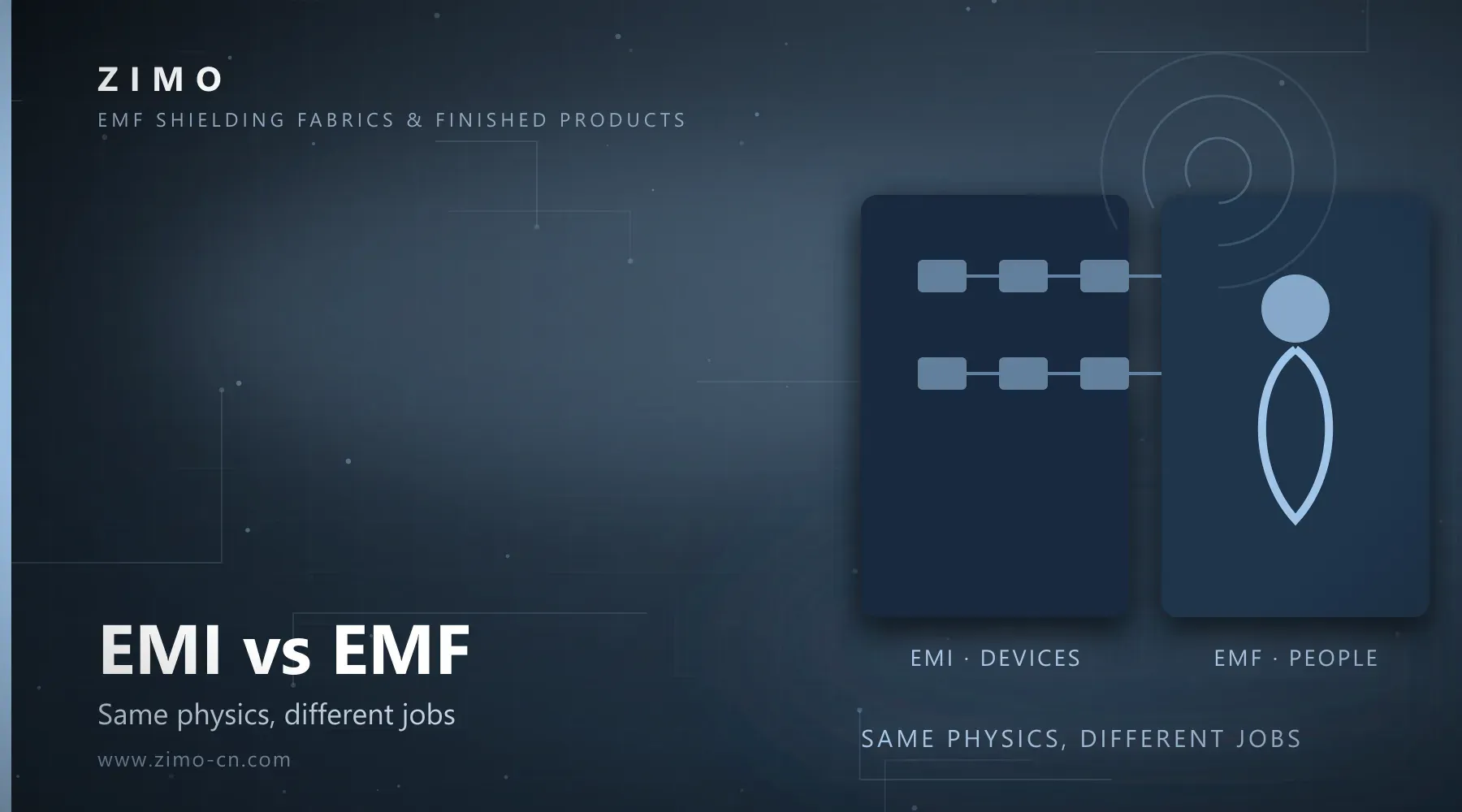
People who search for EMI shielding are usually engineers chasing a device that misbehaves. People who search for EMF shielding are usually deciding how much everyday exposure they are comfortable with. Both searches end at conductive fabric, but the two problems are not interchangeable, and the difference changes what you should ask a supplier. This guide gives the direct answer, then compares EMI vs EMF shielding across goals, scenarios, measurement and materials — and routes each reader to a practical next step.
The Short Answer
Electromagnetic interference (EMI) is an engineering problem. Unwanted electromagnetic energy from circuits, cables, power supplies or transmitters disrupts electronic equipment, and it has to be managed so that devices work correctly.
Electromagnetic fields (EMF) is, in everyday usage, an environment topic. People live and work surrounded by RF signals and low-frequency fields, and some choose to reduce their personal exposure with shielding textiles and accessories.
The physics is shared: a conductive layer reflects and absorbs electromagnetic waves in both cases. What differs is the objective, the standards that apply, and the product form the solution takes. That is why the same copper-nickel fabric can end up as a lining inside an instrument enclosure and as an RFID-blocking layer in a wallet.
EMI vs EMF Shielding at a Glance
Dimension | EMI Shielding | EMF Shielding
Goal | Keep equipment operating correctly | A personal choice to reduce everyday exposure
Typical scenarios | Device enclosures, cable shielding, equipment bays | Wearables, home textiles, everyday-carry items
How it is measured | Shielding effectiveness in dB at defined frequency bands | dB at frequency bands, plus coverage of the body or space
What buyers check | Batch-to-batch consistency and compliance of the end device | Data transparency, comfort, wearability, washability
The Same Physics, Different Goals
What EMI shielding is for
EMI shielding, or electromagnetic interference shielding, protects electronics in two directions: it keeps a device from emitting noise that disturbs its neighbors, and it keeps outside noise from disturbing the device. The material lives in enclosures, cable wraps, gaskets and equipment bays.
Success is measured in decibels of shielding effectiveness at specified frequency bands. But the number on the fabric is only the starting point, because the real test is whole-device compatibility: seams, apertures, screw holes and grounding can leak more than the cloth itself. That is why EMI selection weighs integration and batch consistency as heavily as raw attenuation.
What EMF shielding is for
EMF shielding products — hats, blankets, underwear, aprons, scarves, work uniforms, phone pouches, RFID blocking bags — are chosen by consumers or by brands building for them. Reducing everyday RF exposure is a personal decision, not a compliance requirement, and this guide treats it that way.
Effectiveness is still expressed in dB at frequency bands, yet coverage matters as much as the number: a fabric that attenuates well but covers a small part of the body is a different product from one that encloses it fully. Comfort, drape, breathability and washability decide whether a shielding garment is actually worn day after day.
One Conductive Fabric, Two Selection Logics
The same conductive cloth often serves both worlds. A copper-nickel fabric can be laminated inside an enclosure one week and sewn into a wallet lining the next. The material is identical; the checklist is not.
For EMI work, buyers match the fabric to the frequency band of the interference, then test it in the real assembly, watching for leakage at joints and for durability under handling.
For EMF products, buyers compare tested attenuation first, then coverage and wearing experience: how it drapes, how it feels, how it survives washing.
Attenuation numbers put this in perspective. Zimo's Copper Nickel Fabric is manufacturer-tested at 60–90 dB shielding attenuation, with test reports available on request. Under the standard conversion, 10 dB corresponds to roughly 90% attenuation, 20 dB to 99%, 30 dB to 99.9% and 40 dB to 99.99% — so a 60 dB rating means about 99.9999% of the wave is attenuated in the tested setup and band. Dense Silver Fiber Fabric is manufacturer-tested at 50–80 dB, while Silver Fiber Mesh sits around 20–40 dB. Stainless Steel Fabric takes a different role: thick, stiff and almost without stretch, it suits structural or flat applications rather than soft draping — and we make no dB claim for it.
Standards, Certification and Honest Boundaries
EMI management runs on an established system of EMC standards and certification for finished equipment. Fabric sits at the bottom of that stack: it can contribute, but it does not certify anything. Zimo supplies shielding materials and can support engineers during selection and sampling; we do not perform or substitute for whole-device EMC certification, and we recommend planning compliance testing for the finished product.
For consumer EMF products there is no single equivalent certification regime, which is why data transparency matters. Ask suppliers which numbers are manufacturer-tested, at which bands, and whether reports are available. That is the standard we hold ourselves to.
Where Zimo's Product Line Fits
Shielding fabrics serve both sides of this divide. On the EMF side, Zimo makes finished products — hats, blankets, underwear, aprons, scarves and work uniforms, plus anti-scanning phone pouches and RFID blocking bags — with OEM/ODM support. Standard products ship without minimum order quantity; custom development has MOQs set per project.
On the EMI side, the same fabrics act as materials for engineers to test in their own assemblies. Beyond fabric, we also work with other conductive and absorber materials — contact us for current availability.
FAQ
Can one fabric be used for both EMI and EMF applications?
Often, yes. The shielding mechanism is the same, so a manufacturer-tested conductive fabric can appear in an enclosure and in a wearable. What changes is the specification you prioritize: frequency-band match and integration for EMI, coverage and wearability for EMF.
Is there an essential difference between an EMI shielding fabric and an EMF shielding fabric?
No essential difference in mechanism — both reflect and absorb electromagnetic waves with a conductive structure. The difference is in selection logic: EMI buyers validate inside the whole device, while EMF buyers weigh coverage, comfort and washability alongside tested dB.
Do you make EMI absorbing materials?
Absorbers are distinct from reflective shielding fabrics. We also work with other conductive and absorber materials — contact us for current availability rather than assuming stock.
I am an engineer searching for EMI shielding — what should I read next?
Start with Conductive Fabric Types to compare material families, then How Shielding Effectiveness Is Measured to understand what dB figures do and do not tell you.
I am a consumer searching for EMF protection — where do I start?
Read the EMF Shielding Fabric Guide, which walks through fabric options and how to read their attenuation data before choosing hats, blankets or everyday accessories.
Tell Us Which Problem You Are Solving
Tell us which problem you are solving — interference or exposure — and we will point you to the right fabric, the right data, and samples of standard products with no minimum order. Visit our contact page.
Related Reading
Conductive Fabric Types
How Shielding Effectiveness Is Measured
EMF Shielding Fabric Guide