Oct 3, 2026EMF Wearables
EMF Protection Underwear: Fabric, Shielding and Buying Guide
A buying guide to EMF protection underwear: silver fiber fabric, manufacturer-tested 50–80 dB shielding, OEM options and questions to ask suppliers.
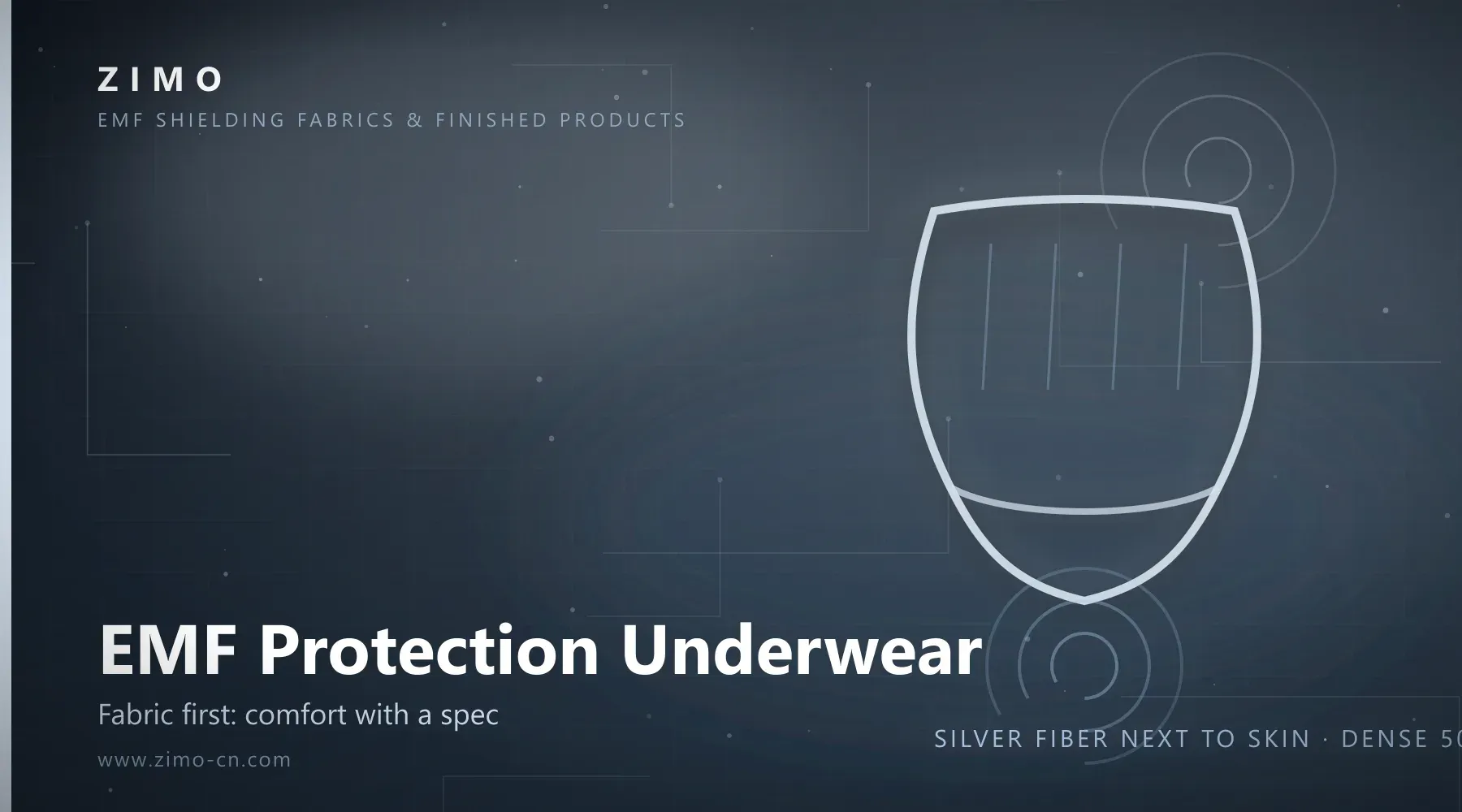
EMF protection underwear is the most specification-sensitive category in shielding apparel: the garment sits against the skin, is worn daily, and goes through more wash cycles than almost any other textile product, so fabric and construction decisions carry more weight here than in outer layers. This guide serves two audiences: brand product and sourcing teams evaluating the category, and individual buyers who want to understand what the product is. It covers typical styles, the fabric used for skin-contact garments, five sourcing criteria, Zimo's OEM options and the questions worth asking any supplier.
What Is EMF Protection Underwear?
Radiation shielding underwear — also listed by sellers as anti radiation underwear — is standard-cut underwear made with, or lined with, conductive fabric that attenuates radiofrequency signals across the area it covers. It is designed for people who want to reduce local exposure from everyday wireless sources; it works as a garment, not a device.
The category includes three established style groups:
Briefs and boxers. The core styles for the general market, produced with shielding fabric as the main body or as a front-panel lining.
Maternity belly-band styles. Briefs and bands cut with an extended front panel over the belly — described here purely as a garment style; see the FAQ.
Layering pieces. Some buyers pair underwear with an EMF protection apron or working uniform, because attenuation is only meaningful across the area a garment actually covers.
Why Dense Silver Fiber Fabric Is the Core Material
For a garment worn against the skin all day, fabric choice is the product decision. Zimo uses dense silver fiber fabric for its underwear because it combines what this category cannot compromise on:
Soft, skin-friendly hand feel. Silver fiber is comfortable next to the skin — essential when the fabric is the garment itself.
Breathability. The dense weave remains breathable enough for all-day wear.
Naturally antibacterial. Silver fiber is naturally antibacterial, a practical property in any garment worn close to the skin.
Washable. Made to be washed as part of normal garment care — a daily-wear requirement.
On shielding performance: dense silver fiber fabric in Zimo's range is manufacturer-tested at 50–80 dB shielding attenuation, and test reports are available on request. Converted on the standard dB scale, 20 dB corresponds to about 99% attenuation and 40 dB to about 99.99%; on that scale, a 50–80 dB fabric sits above the 99.99% marker.
One caveat matters: dB figures describe the fabric, not the finished garment. Attenuation in use depends on the coverage area, the number of layers, and how the piece is cut and sewn — a full-body brief will not perform identically to a front-panel lining. Construction details deserve the same scrutiny as the fabric data sheet.
Beyond underwear, Zimo's shielding range also includes copper nickel fabric, manufacturer-tested at 60–90 dB with test reports available on request, and other conductive fabrics available on request.
Five Sourcing Criteria for Brands
Buyers building an EMF protection underwear line should treat five criteria as a minimum checklist:
1. Shielding figures and test basis. Ask for dB values and what stands behind them: which frequency bands were measured, whether figures are manufacturer-tested, and whether reports are available. "50–80 dB, manufacturer-tested, reports on request" is a verifiable starting point; a bare "99% blocking" claim is not.
2. Skin-contact comfort and fabric weight. Ask for the GSM (grams per square meter) of the exact fabric in each style, not just the product family. Weight drives thickness, drape and warm-weather comfort, and brands often combine weights across a range.
3. Wash durability. Shielding relies on a continuous conductive structure, which washing and abrasion affect over time. Ask how wash durability is validated and what care instructions apply — with a test basis, not a marketing number.
4. Elastic blend ratio. Stretch fibers give underwear its fit and recovery. Ask for the full composition and the elastic blend percentage: the ratio affects comfort, shape retention after washing, and how consistently the shielding layer sits in place.
5. Size grading. Confirm whether the supplier can work from your size chart or only from standard blocks, and how grading is handled for maternity cuts. This is often where OEM projects move quickly or stall.
OEM and Private Label with Zimo
Zimo (www.zimo-cn.com) manufactures shielding fabrics and finished garments for EMF protection brands, e-commerce sellers and garment makers, and its underwear line is available for OEM and ODM production: brands can start from existing styles under their own label or develop custom sizes, fabric weights and designs.
The commercial policy is deliberately small-order friendly. Standard items carry no MOQ, so a brand can order samples or a first small batch, check fit and comfort, and test sell-through before committing to inventory. Customization — sizes, GSM, styles — is available with MOQ determined per requirement, agreed case by case.
For a first-time entrant, that is the practical path: validate on standard items, then scale into a private-label program. The same fabric platform extends to EMF protection hats, blankets, aprons, scarves and working uniforms, plus anti-scanning phone pouches and RFID blocking bags.
What Individual Buyers Should Ask
Consumers can apply the same logic in miniature, with three questions:
Where does the fabric come from? A listing worth considering names the fabric type — for this category, dense silver fiber fabric — not just a country of origin.
What is the dB figure and its basis? "Manufacturer-tested, test reports available on request" is a real answer; an unexplained percentage is not.
How is it washed? Follow the supplier's care instructions, since the conductive structure is what carries the shielding.
Keep expectations anchored: figures describe fabric under test conditions, and a garment attenuates only across the area it covers. Underwear is best understood as one layer in a broader setup, paired with an apron or a blanket where needed.
Frequently Asked Questions
Can EMF protection underwear be worn next to the skin?
Yes. Dense silver fiber fabric is soft, skin-friendly and naturally antibacterial, and the finished garments are designed to be worn as everyday underwear.
How long does the shielding last with repeated washing?
There is no universal number; a supplier who quotes one should be able to show the test behind it. Attenuation depends on a continuous conductive structure, which repeated washing and abrasion affect over time. Follow the care instructions provided with the garment and verify wash-life expectations with the fabric supplier.
Is maternity EMF protection underwear a medical product?
No. It is a garment, not a medical device, and it is not intended to diagnose, treat, cure or prevent any condition. Maternity styles are simply cut with an extended front panel. No underwear should be expected to deliver medical outcomes.
Can we customize the size system?
Yes. Sizes, fabric weights and styles are all customizable within the OEM/ODM program, including working from a brand's own size chart, with MOQ determined per requirement.
What is the minimum order quantity?
Standard items carry no MOQ. Customized products have an MOQ determined case by case according to the requirement.
Ask About Fabric Supply and OEM Programs
Brands building an underwear or maternity line can ask about fabric supply & OEM programs to receive fabric specifications, manufacturer-tested shielding data with test reports on request, and sample terms under the no-MOQ policy for standard items. Individual buyers are welcome to send an inquiry as well.
Related Reading
Silver fiber fabric: the core material for skin-contact shielding garments, with its specifications and attenuation figures.
EMF protection apron: a layering piece that pairs with underwear-style shielding for extended coverage.
Silver vs. copper nickel fabric: how the two fabric families compare before you commit.