Oct 3, 2026EMF Wearables
EMF Protection Apron: Belly-Down Shielding for Work and Home
An EMF protection apron covers the belly and lap with tested shielding fabric. Compare silver fiber and copper nickel styles, dB figures, and buying tips.
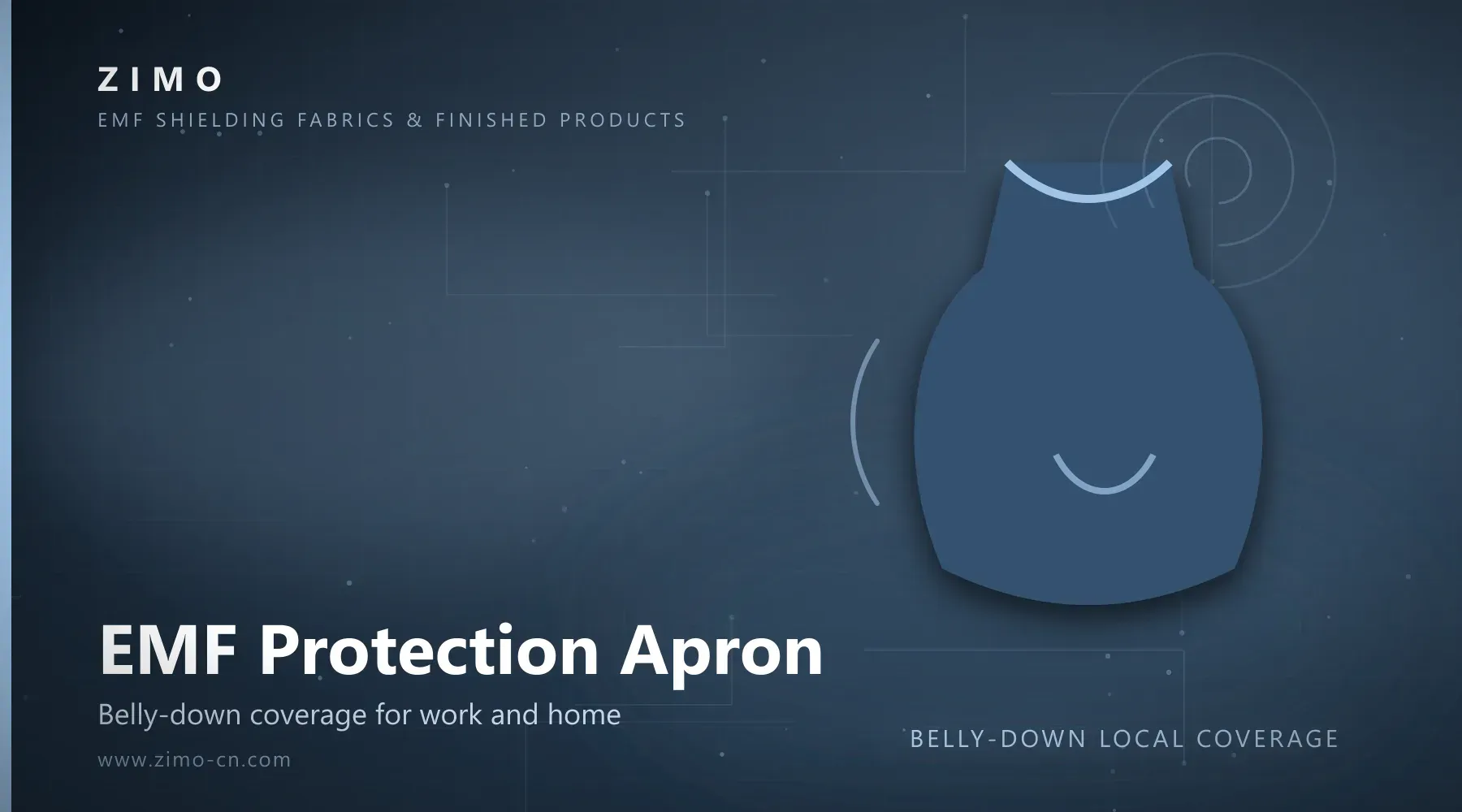
An EMF protection apron is a wearable shielding panel that hangs over the abdomen and upper legs, giving local, belly-down coverage to laptop users, to people who stand for long hours near kitchen appliances or workshop equipment, and to buyers who want partial coverage over the belly area. This page covers the two apron styles Zimo produces, the fabrics behind them with tested attenuation figures, what partial coverage can and cannot do, and a short buying checklist. The product is sometimes listed as an anti radiation apron or, for maternity cuts, as a radiation apron for pregnancy; throughout, we describe what the garment physically covers rather than health outcomes.
What Is an EMF Protection Apron?
An apron-style shield solves a simple problem: daily attention centers on the torso and lap, and a full garment or a shielded room is often more than the situation calls for. The apron hangs from the shoulders or waist, drapes over the belly and thighs, and attenuates part of the radio-frequency energy reaching the covered area. Coverage is local by design, which is exactly what makes an apron practical: light, easy to take on and off, and wearable over or under regular clothing.
Zimo makes aprons in two broad positions:
Daily Belly Panel Style
The daily style is cut light and soft so it can sit close to the body. It is designed to hang over the abdomen and the lap while seated, forming a belly-down partial coverage panel. This is the cut most often searched as a radiation apron for pregnancy, and it is also used by laptop-heavy workers who want a layer between device and body. We describe the coverage geometry deliberately: the product covers the belly and lap area, and health claims are left out of the conversation entirely.
Work and Workshop Style
The work style is built to be worn outside clothing: a sturdier cut, a more durable fabric, and a size suited to long stretches at a kitchen counter, a workbench, or a desk in an equipment-filled office. A cut with adjustable straps sits comfortably over seasonal layers.
The Shielding Fabrics Behind the Apron
Silver Fiber Fabric for Close-to-Body Styles
For styles meant to sit against the skin or over thin clothing, Zimo uses dense silver fiber fabric: manufacturer-tested shielding attenuation of 50–80 dB for the denser grades, with test reports available on request. Beyond attenuation, the fabric is soft and breathable, and silver is naturally antimicrobial, which matters for hours of wear against the body.
At the standard conversion, 20 dB is about 99% attenuation and 40 dB about 99.99% at the tested frequencies; both fabric families in Zimo aprons sit at or above that scale's upper end.
Copper Nickel Fabric for Durable Styles
For outer-wearable work aprons, copper nickel fabric is the typical choice: manufacturer-tested shielding attenuation in the 60–90 dB range, with test reports available on request. It is paired here with the sturdier cut and outer-wear positioning of the work style.
One point applies to every figure on this page: attenuation varies with the frequency band tested, so a dB number is meaningful only alongside its test scope. When comparing suppliers, ask which frequencies the measurement covered and whether the report can be shared; ours can, on request. Other conductive fabrics are available on request.
Typical Use Scenarios
These are described neutrally, as coverage use cases rather than health guidance:
Laptop on the lap. The apron drapes over the thighs and belly while you work, adding a shielding layer between device and body.
Long hours at a counter or bench. Kitchen, workshop, or studio stations where you stand close to equipment; the apron covers the torso and upper legs throughout.
Combined coverage. An apron pairs with other Zimo pieces: a shielding blanket over the legs while seated, or a working uniform underneath, so adjacent areas are covered together.
How to Choose an EMF Protection Apron
Four checks cover most decisions:
Coverage area and cut. Measure the area you want covered and compare it with the panel size. An adjustable shoulder strap and waist tie keep the panel in place over different clothing layers.
Fabric and dB figure with its test scope. Ask for the attenuation range and how it was measured. Manufacturer-tested figures with reports available on request are the honest standard; a bare dB number is not.
Breathability and weight. For close-to-body or warm-climate use, lighter-weight dense silver fiber is more comfortable than a heavier build; for outer wear, durability can take priority.
Washability. Care matters for a repeated-use garment: follow the care label on the specific product, and ask us before ordering if you have a preferred routine.
What an Apron Can and Cannot Do
This section is deliberately direct.
It protects the covered area only. An apron shields what sits behind the fabric panel. Arms, head, and sides outside the panel are outside the shield.
Edge leakage is normal. RF energy wraps around the edges of any partial shield, so attenuation at the hem and sides is lower than at the center of the panel. This is physics, not a defect, and it applies to every partial-coverage shielding garment on the market.
It is not a medical device. Zimo aprons are general-purpose shielding garments, not medical protective equipment, and they do not replace the lead aprons used in radiology and clinical settings. We make no health or therapeutic claims for any product on this page.
For Brands and Sellers: OEM and Customization
For EMF protection brands, e-commerce sellers, and manufacturers adding aprons to their line, Zimo supplies finished aprons on an OEM/ODM basis:
Custom sizing and cut. Panel dimensions, strap systems, and silhouettes can be adjusted for maternity, daily, or workshop positioning.
Fabric combination. Silver fiber for close-to-body styles, copper nickel for durable outer styles, or other conductive fabrics on request.
Logo and branding. Finished aprons can carry your logo for retail-ready delivery.
Standard items carry no MOQ; for customized orders, MOQ is confirmed per requirement, so new brands can start standard and move to custom as demand grows.
Request a Quote
Whether you need one standard apron or a custom maternity or workshop run, request a quote or ask about customization. Tell us the style, fabric, and target market, and we will reply with options and lead times.
FAQ
Is an EMF protection apron a medical device?
No. It is a general-purpose shielding garment, not medical protective equipment, and it does not replace the lead aprons used in radiology. For medical questions, consult a healthcare professional.
Can I wear it against the skin?
Silver fiber styles are made for close-to-body wear: soft, breathable, and naturally antimicrobial. Copper nickel styles are better suited to wearing over clothing. Check each product page for the intended wear layer.
How should I wash it?
Follow the care label on the specific product. As a general rule for conductive fabrics: gentle wash, mild detergent, no bleach, no high-heat drying. When in doubt, ask us before the first wash.
Can I order a custom size or add my logo?
Yes. Sizes, cuts, and fabric combinations can be customized, and finished aprons can carry your logo under OEM/ODM. Custom MOQ is confirmed per requirement; standard items have no MOQ.
Will it be hot to wear in summer?
Any added layer adds some warmth, which is honest physics. For warm climates, choose a lighter-weight silver fiber style: breathable, designed for close-to-body wear, with the fabric weight listed on the product page.
Related Reading
Silver Fiber Fabric — the close-to-body fabric behind the daily and maternity styles.
EMF Protection Underwear — a lighter partial-coverage option that pairs with an apron.
Copper Nickel Fabric — the higher-attenuation fabric behind the durable work styles.