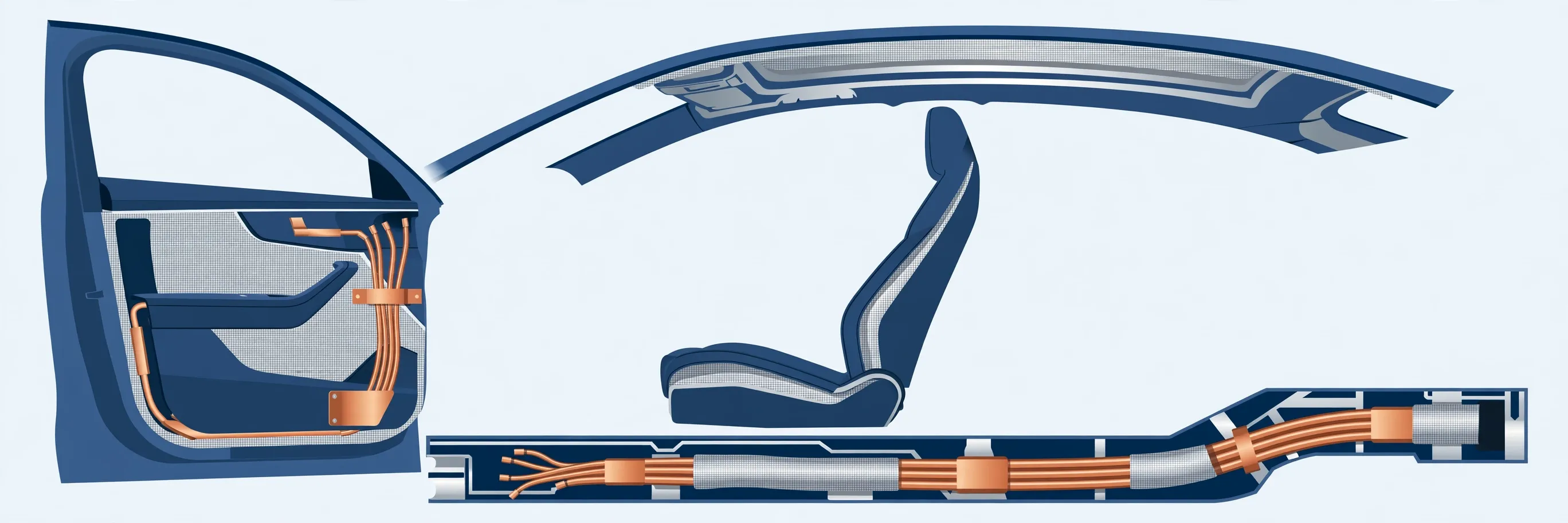
Copper Nickel Fabric for EMI Cable Wrapping and Harness Shielding
Wrapping cables and harnesses with copper nickel fabric: overlap and closure, connector termination, flex handling and end-to-end continuity checks.
Copper-nickel fabric is a practical cable wrapping shielding fabric when a harness EMI shielding job needs a continuous, flexible conductive layer added after the cable is built. It is not the automatic answer for every bundle. Foil tape, braid and fabric solve different problems, and the right choice depends on flex life, connector access and how the assembly will be inspected.
This guide covers the decision, overlap and closure details, connector termination, flex, added bulk and end-to-end verification.
When Cable Wrapping Shielding Fabric Beats Foil Tape or Braid
Copper-nickel fabric is not the default for every cable. Compare the flex requirement, connector hardware and whether the harness can be built around the shield.
Foil Tape: Compact but Fragile
Foil tape is thin and fits tight spaces, but its adhesive may not conduct through its thickness. The wrap can look continuous while the electrical path depends on edge contact. Foil work-hardens and cracks at a bend, and it is hard to bridge a branch or replace a section. Use it for short, static runs, not as a substitute for a flex-rated shield.
Braid: The Flex-Life Benchmark
Tubular braid is the usual choice when a harness must flex repeatedly. It provides continuous coverage around the bundle, terminates well into a conductive backshell, and tolerates movement better than thin foil. Its limitation is assembly. Braid generally has to be slipped over the cable before connectors are fitted, and branches require separate pieces and careful splicing. Retrofitting a finished harness is awkward.
Fabric: Retrofit Coverage Where the Geometry Is Awkward
A conductive fabric cable wrap can be cut and applied after the harness is built. It conforms around branches and bulky connector bodies, and the overlap can be bonded or sewn. That suits prototypes, low-volume builds, rework and harnesses that will not pass through braid. It is a poor first choice for continuous flex, hot or abrasive environments, or a moulded backshell that is the only practical termination. Fabric is not a fire barrier and does not seal against water or dust.
Building a Harness EMI Shielding Wrap
Overlap and Direction
A wrap is only as continuous as its seams. Lap each turn in the same direction, like roof shingles, and keep the overlap away from sharp edges. Start with 25 percent overlap on straight runs and 50 percent at bends, branches and anywhere the wrap can shift. Bias-cut strips conform better around curves, but their edges fray, so plan a clean closure.
A Bonded Closure, Not Just a Tidy One
The closure must carry current across the overlap. Conductive adhesive tape can work if the adhesive conducts and the joint is burnished; ordinary tape only holds the fabric. Conductive thread gives a flexible electrical seam at close stitch spacing; measure resistance across the seam rather than assuming the stitch bonds. Mechanical clamps or crimp bands suit ends and high-vibration points. Test each closure type on a sample first.
Terminating Cable Wrapping Shielding Fabric at Connectors
An unterminated wrap is an antenna. At each connector, bring the fabric into full-circumference contact with the conductive shell or backshell. Extend it under the backshell clamp, against a conductive gasket or under a metal band, then tighten the strain relief. A single drain wire or narrow pigtail is a poor RF connection because its inductance rises with length; use it only as a secondary path.
Bond the connector shell to the equipment chassis, and confirm the shell is conductive. A plastic connector body cannot become a shielded termination because fabric is wrapped over it. Where dissimilar metals meet, consider galvanic corrosion; copper-nickel against aluminum may need a plated interface in wet or salty service. For RF containment, bond at both ends unless the system grounding design says otherwise. The shield must not carry operating current and must stay isolated from signal and power conductors.
How a Conductive Fabric Cable Wrap Handles Movement
Flexible is not the same as unlimited flex. A fabric wrap with a service loop and generous bend radius suits occasional movement. For continuous flex, the fabric, closure and termination all see strain; a stitched seam may tolerate bending better than a brittle adhesive, and a braid may be the better shield. Test the actual bend radius and cycle count, not a straight sample.
Keep the wrap from carrying tensile load. Clamp the cable, not the fabric, at both ends, leave a small service loop, avoid creasing the fabric at a connector, and route the closure away from the outer radius of a tight bend where practical. After a flex test, inspect for frayed edges, cracked adhesive, loose stitches and movement at the backshell. Recheck continuity because a shield can look intact while the bond has opened.
Weight, Bulk and Harness Layout
Every wrap adds diameter. Overlap consumes width, so plan strip length from the wrap pitch rather than the cable length alone. Estimate the finished diameter as the bundle diameter plus two fabric thicknesses, the closure, and clearance for the outer sleeve. That matters in dense harnesses, conduit fill calculations, connector strain relief and bend radius.
Recheck clip spacing, support points and the route through bulkheads. If the harness needs abrasion protection, fit an outer sleeve that is compatible with the environment; it does not have to be conductive, provided the underlying shield remains continuous and accessible for inspection. Leave a folded test tab outside the outer sleeve at each end and at branch joints, and do not trap moisture against the fabric.
Verifying Continuity from End to End
With the harness de-energized and under qualified control, inspect for butt seams, exposed dielectric, loose fibres near contacts and unbonded closures. Measure resistance from shell to shell, and from each shell to points along the wrap, including branch joints and overlap edges. Use a four-wire milliohmmeter or a low-range meter; a continuity beeper cannot show a good RF bond.
Compare readings with a known-good assembly or an agreed limit. Check shield-to-conductor insulation resistance before power, per the assembly specification. Continuity proves a DC path, not shielding effectiveness. For critical EMC work, verify transfer impedance, bulk current injection or radiated performance on the finished harness with its connectors and routing. A flat sample test does not represent a finished harness.
Sourcing Copper Nickel Fabric for Cable Work
Zimo's copper-nickel fabric is manufacturer-tested at 60–90 dB. That figure describes the material under test conditions, not a completed harness, and the test report is available on request. Ask for the exact article's width, weight and specification, and trial the wrap on a short mock-up before production. Standard items carry no MOQ; custom widths, weights and finished components have an MOQ confirmed per requirement, and OEM/ODM is available for cut wraps or other finished shielding parts.
FAQ
Is fabric wrap as good as braid for a flexing harness?
Not as a general rule. Braid usually has the better flex life and a more established backshell termination. Fabric is stronger where the harness is already built, the route branches, or the connector cannot pass through braid. Choose by the flex test and termination hardware, not by the material alone.
Does the wrap need to be grounded?
Bond it to the equipment chassis or the designated shield reference for static and low-frequency field control, following local electrical codes and the system's grounding plan. The RF attenuation comes from the conductive layer and continuous bonds, not from the earth connection. A qualified person should approve the bonding arrangement.
Can I close the overlap with ordinary adhesive tape?
Only if the tape is specified as conductive and the joint is tested. Ordinary adhesive holds the fabric mechanically but may leave an insulating layer between the two surfaces. Use a conductive closure, burnish it, and measure resistance across the seam.
How much overlap should I use?
Start with about 25 percent on straight runs and 50 percent at bends and branches, then verify on a sample. More overlap consumes more width and adds bulk, while less overlap raises the risk of an open seam under movement. There is no universal figure without the cable construction and test requirement.
Is the fabric a fire barrier or a water seal?
No. It is a conductive textile, not a fire-rated barrier, environmental seal or strain-relief device. Protect it with suitable sleeving or housing where those functions are required.
Related Reading
• Copper Nickel Fabric: EMF and RFID Shielding Fabric
• Conductive Fabric Types: An Overview of Shielding Textiles
• How to Choose EMF Fabric by GSM and Width
• EMF Fabric Testing Methods and What the Numbers Mean
• Does EMF Shielding Fabric Need Grounding?
Request the Spec Sheet and a Sample
Tell us the cable diameter, branch layout, connector type, expected flex and the frequencies you need to address. Describe the application and request the matching article, spec sheet and samples through the contact page.