Oct 3, 2026Guides & Education
5G and EMF Shielding: What Changes and What Doesn't
A calm, data-first look at 5G EMF protection: why shielding is frequency-dependent, what dB ratings really mean, and how to verify any fabric.
Search for 5G EMF protection and you will meet two extremes: products promising to "block 5G" completely, and comment threads insisting nobody should care. Neither helps you choose a material. This page takes the calmer path — what 5G actually is, why every shielding fabric behaves differently across frequencies, and which questions get you a real answer, whether you are a consumer wondering what your current fabric still does, or a brand seller answering customer emails.
What 5G Actually Is
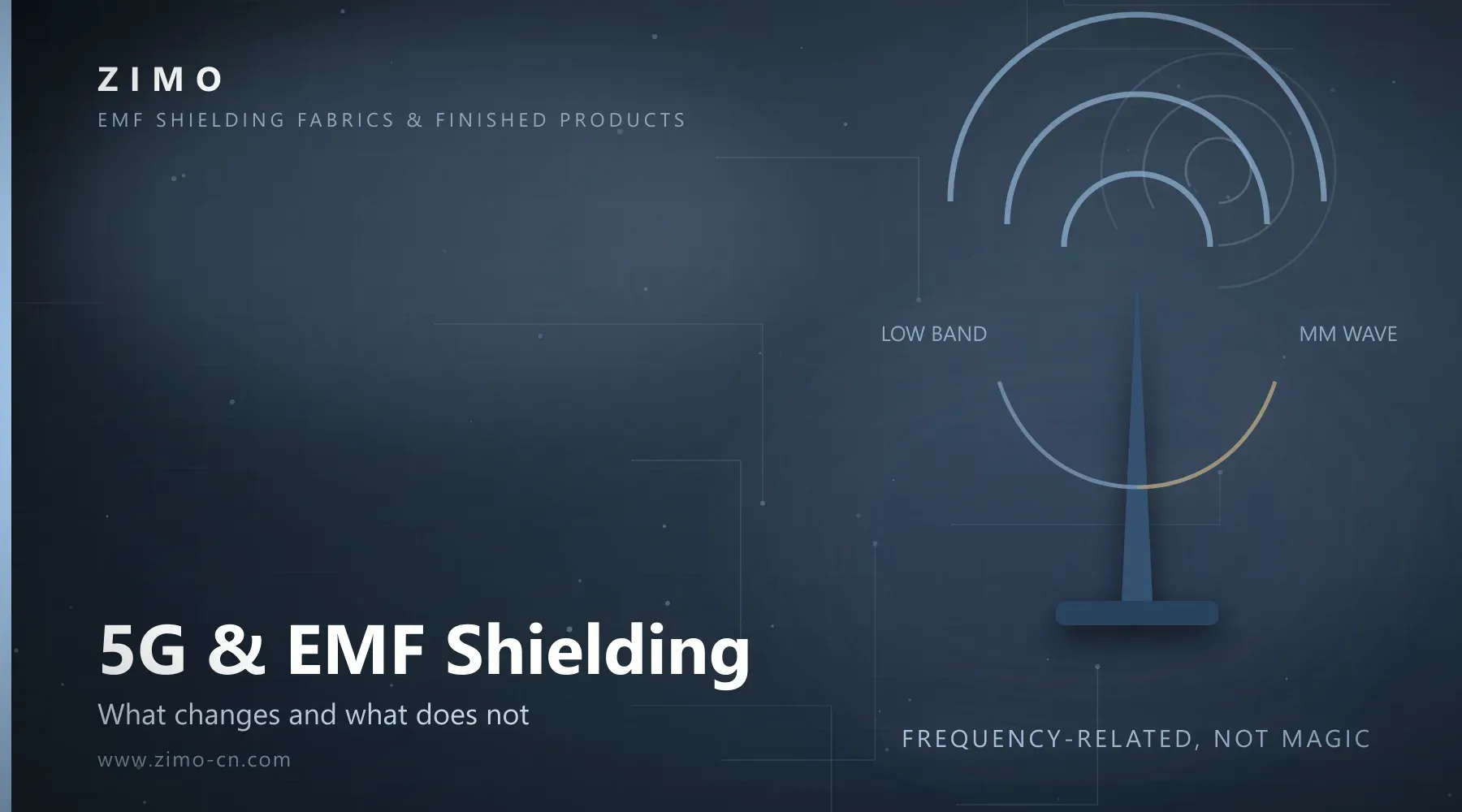
5G is not one frequency. It is a wider combination of bands used together: low-band spectrum (roughly below 1 GHz) that travels far and covers wide areas, mid-band spectrum (roughly 1–6 GHz) that balances speed and range, and high-band millimeter wave (around 24 GHz and above) that delivers very high speeds over short distances. Different countries and operators combine these bands differently, and deployments keep evolving. That mix is why the single word "5G" tells you surprisingly little about which frequencies are actually around you.
The Idea That Does the Most Work: Shielding Is Frequency-Dependent
Shielding fabrics have always been frequency-related. The same cloth can absorb and reflect energy differently at different wavelengths, so it may measure strongly at one frequency and modestly at another. That was true before 5G and is true now. So when a customer asks, "does EMF fabric block 5G?", the honest answer is: it depends on the band and on the specific fabric spec — and that answer has applied to every signal, long before 5G existed.
Why "5G Shielding Fabric" Is Mostly a Marketing Phrase
No material family targets "5G" as such, because 5G spans too many frequencies. The only wording that means anything is measurable: "this spec measured X dB at Y GHz." When a listing advertises 5G shielding fabric with no frequency and no number behind it, treat the label as marketing and ask for the underlying data. Suppliers who test their materials normally have it; those who do not will change the subject.
What dB Ratings Actually Convert To
Shielding effectiveness is usually quoted in decibels (dB). Every additional 10 dB means roughly another order of magnitude less signal power getting through. The standard conversions:
Measured shielding | Approximate signal power reduction at the tested frequency
10 dB | ~90%
20 dB | ~99%
30 dB | ~99.9%
40 dB | ~99.99%
Two cautions when reading such numbers. First, each percentage describes the frequency where the fabric was tested — it is not a promise across all frequencies at once. Second, real-world results also depend on usage: seams, openings and how completely an enclosure wraps what it protects matter as much as the cloth itself.
Millimeter Wave Shielding: What Genuinely Changes
High bands behave differently, and millimeter wave shielding is worth discussing separately for that reason. Signals at 24 GHz and above are more directional and far less able to pass through walls, glass or foliage — which is exactly why millimeter wave networks need many small cells and are sensitive to coverage gaps. For shielding purposes, everyday surroundings already attenuate these bands substantially.
Meanwhile, low- and mid-band 5G sits much closer to the frequencies shielding fabrics have historically been tested against, and because low- and mid-band cells cover wide areas, these bands remain among the more common signals in daily environments.
Whether and how much you want to reduce exposure is a personal choice. It is not a question this page — or any fabric datasheet — can settle for you.
How to Ask a Supplier About 5G Shielding
Three questions cut through the noise, whether you are buying fabric for production or answering your own customers:
Which frequency band do you care about? Start from the signal, not the product name.
What has this specific spec measured at that band, in dB? A range without frequencies is not an answer.
Is there a test report behind that measurement? Manufacturer-tested figures with reports available on request are the norm among serious suppliers.
To understand how those numbers are produced, see how shielding effectiveness is measured.
Zimo's Fabric Data, Spec by Spec
We publish manufacturer-tested ranges and provide test reports on request for applicable specs. The figures below describe tested frequencies, not a guarantee for every band:
Copper Nickel Fabric: 60–90 dB (manufacturer-tested). At tested frequencies this sits far above the 40 dB row in the table above. If you are weighing conductor types, see silver vs copper nickel fabric.
Silver Fiber Fabric (dense, higher-grade specs): 50–80 dB (manufacturer-tested).
Silver Fiber Mesh: approximately 20–40 dB. The open mesh trades attenuation for breathability and flexibility, a reasonable trade where lighter reduction is sufficient.
Stainless Steel Fabric is also available where a stiff, low-stretch material is preferred; we do not quote a single dB figure for it — ask for spec-level data.
Standard products ship with no MOQ. Custom production carries a MOQ set per requirement, and finished goods — from hats and blankets to anti-scanning phone pouches and RFID blocking bags — are available OEM/ODM.
FAQ
Does EMF fabric block 5G?
It depends on the band and the spec. Low- and mid-band 5G falls within ranges many shielding fabrics have long been measured against; millimeter wave behaves differently. The only dependable answer comes from measured dB at the frequency you care about — so ask for that data by name.
Do I need special "5G shielding fabric"?
No. "5G shielding fabric" is a marketing label, not a technical category. What matters is measured performance at the relevant frequency. Compare specs and test reports rather than packaging claims. Our rundown of EMF protection myths and facts covers similar overclaims.
Which is easier to shield: millimeter wave or low band?
As a general rule, higher-frequency signals are easier to attenuate — ordinary walls already weaken them heavily, which is why millimeter wave coverage is gap-prone. Low-band signals pass through more material, so they ask more of a fabric. Even so, the deciding factor is always a specific fabric's measured dB at a specific frequency.
Has 5G made older shielding fabrics obsolete?
No. Fabric responds to frequencies, not to network generations. A fabric that measured well at a given band before 5G measures the same today. What has changed is the wider spread of bands in use, which makes spec-level data more useful than it used to be.
How can I verify fabric I have already bought?
Ask the seller for the test report behind any dB claim, including which frequencies were measured. If you own an RF meter, before-and-after readings at a known band can indicate relative reduction, though consumer meters have real limitations. For background on what credible numbers look like, start with how shielding effectiveness is measured.
Ask which fabric specs suit the bands you care about. Tell us the frequency band and the application — a wearable, a phone pouch, a room lining — and we will point you to the right spec and send test reports where available. Contact us.
Related Reading
How Shielding Effectiveness Is Measured
EMF Shielding Fabric Guide
EMF Protection Myths and Facts