Oct 3, 2026Shielding Fabrics
Silver vs Copper Nickel Fabric: Which Shielding Fabric to Choose
Silver vs copper nickel fabric compared: dB ranges, comfort, care, cost and use-case advice for EMF shielding brands, makers and buyers.
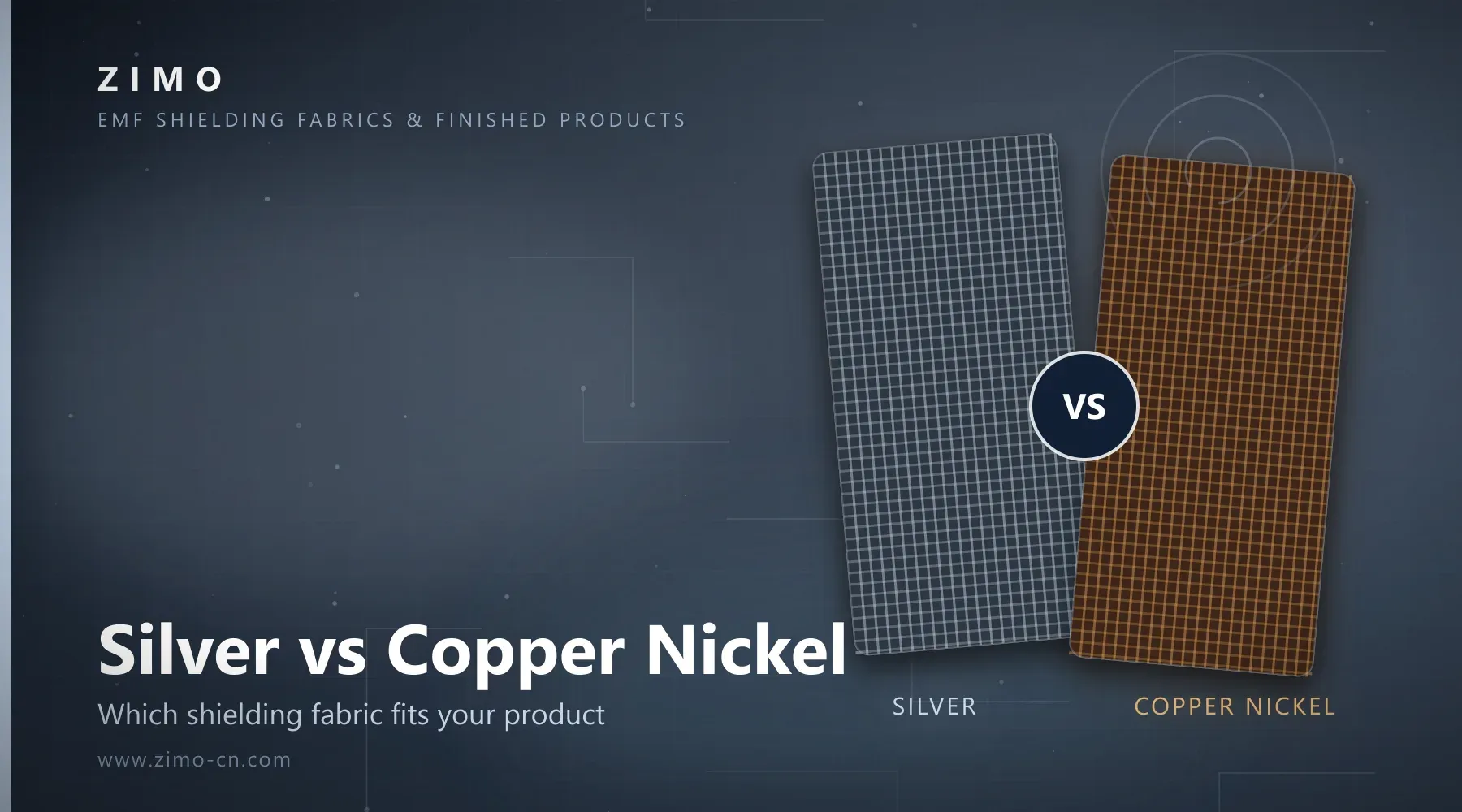
If you are shortlisting a conductive textile for a product line, or choosing material for a serious DIY build, the silver vs copper nickel fabric question comes down to four things: attenuation range, comfort against the skin, oxidation and care, and cost positioning. Below: a quick answer, a side-by-side shielding fabric comparison table, and scenario-based recommendations to move you straight to sampling.
All attenuation figures in this article are manufacturer-tested values for Zimo fabrics; test reports available on request.
Quick Answer: Which Fabric Should You Choose?
Skin contact and comfort first (underwear, scarves, hat linings): choose dense silver fiber fabric — soft, flexible, naturally antibacterial, manufacturer-tested at 50–80 dB.
Higher tested attenuation and cost efficiency (wallets, RFID blocking bags, anti-scanning phone pouches, shielding panels): choose copper nickel fabric — manufacturer-tested at 60–90 dB, usually the more economical option.
Airflow matters (bed canopies, mosquito-net style protection): choose silver fiber mesh — an open net structure, approximately 20–40 dB, manufacturer-tested.
Building a finished product? Many items combine both: for example, a hat with a hard-wearing outer shell and a soft silver fiber inner layer.
For reference, attenuation converts to signal reduction roughly as follows: 10 dB ≈ 90%, 20 dB ≈ 99%, 30 dB ≈ 99.9% and 40 dB ≈ 99.99%. Both dense fabrics sit well above the 40 dB mark in their tested ranges; the open mesh trades some attenuation for airflow.
Silver vs Copper Nickel Fabric: Side-by-Side Comparison
Attribute | Copper Nickel Fabric | Silver Fiber Fabric (dense) | Silver Fiber Mesh
Shielding attenuation (manufacturer-tested) | 60–90 dB | 50–80 dB | Approx. 20–40 dB
Approximate signal reduction | Well above 99.99% in tested range | Well above 99.99% in tested range | Roughly 99%–99.99%
Hand feel and skin contact | Structured, technical hand | Soft, drapes well, skin-friendly | Light net-like structure
Breathability | Denser cloth; ask for weave and GSM | Comfortable for garments | Excellent airflow
Oxidation behavior | Copper-nickel alloy is comparatively oxidation-tolerant | Silver may tarnish gradually with air and sweat | Same silver-based behavior
Washing and care | More tolerant; still follow supplied care instructions | Gentler care recommended | Gentle handling to protect the net
Typical applications | Wallets, RFID bags, pouches, aprons, working uniforms | Underwear, blankets, scarves, hat linings | Canopies, mosquito-net style curtains
Cost positioning | Usually more economical | Usually premium | Premium; chosen where airflow is essential
The two dense fabrics overlap heavily, so the decision is rarely which number is higher on paper. The best fabric for EMF shielding is the one matched to the application: washing frequency, flexing, skin contact and humidity.
Choosing by Application
Wallets, RFID Blocking Bags and Phone Pouches
For small leather goods and bag makers, copper nickel fabric is the usual default: the higher of the two tested attenuation bands, a structured hand that suits wallet and bag linings, and a cost position that fits volume production. RFID blocking does not demand extreme attenuation, but the headroom means the design does not depend on perfect seam closure. Finished anti-scanning phone pouches are also available for OEM/ODM.
Underwear, Scarves and Skin-Contact Apparel
For anything worn directly on skin, dense silver fiber fabric wins on comfort: soft, naturally antibacterial, and it drapes well — properties that matter for garments worn all day. Its manufacturer-tested attenuation of 50–80 dB sits in the same class as copper nickel for typical garment use. Underwear, scarves and blankets in silver fiber are among the most requested finished items, available standard with no MOQ or as OEM/ODM.
Canopies and Mosquito-Net Style Protection
A canopy has a constraint no other product has: you sleep under it and need to see and breathe through it. Silver fiber mesh is built for this — an open net structure with approximately 20–40 dB manufacturer-tested attenuation, roughly 99%–99.99% signal reduction. It is a deliberate trade: less attenuation than a dense fabric, but airflow a dense fabric cannot deliver.
Workwear, Aprons and Blankets
Working uniforms and aprons need attenuation but also have to survive repeated laundering and daily wear; copper nickel fabric is often specified here for its durability and cost profile. Blankets, used close to the body for long hours, lean toward silver fiber for softness. Many buyers sample both and test them against their real washing process before committing to a material.
Mixing Both Materials in One Product
Often the practical answer to the silver vs copper nickel fabric question is both, in different zones. A common EMF protection hat pairs a durable outer fabric with a soft silver fiber lining. Bags can use copper nickel in main panels and a softer fabric in handles or trims. Finished products are offered OEM/ODM, with customization of size, weight (GSM) and style, so a zoned design can be quoted as one build.
Aging, Washing and Test Transparency
An honest note many product pages skip: both fabrics change gradually over their service life. Silver fiber can tarnish with air and sweat, and repeated washing slowly affects any conductive textile; copper nickel is generally more oxidation-tolerant but not immune to wear. Attenuation is best understood as a range that drifts slowly, not a fixed number guaranteed for life.
Three habits for B2B buyers:
Ask for the data first. Test reports are available on request for applicable specifications — before sampling, not after production.
Test your real washing cycle. A fabric that survives your customers' laundry habits beats the highest laboratory figure.
Ship care instructions with the product. Clear washing guidance protects both attenuation and the customer relationship.
FAQ
Which Fabric Attenuates More, Silver or Copper Nickel?
In Zimo's manufacturer-tested data, copper nickel fabric spans 60–90 dB and dense silver fiber fabric spans 50–80 dB — overlapping ranges, with copper nickel reaching the higher ceiling. At 40 dB roughly 99.99% of incident signal is attenuated, so both dense fabrics operate well beyond that level. Test reports available on request.
Is Silver Fiber Fabric Suitable for Skin Contact?
Yes. It is soft, drapes well and is naturally antibacterial, which is why it is the standard choice for underwear, scarves and hat linings. To be precise about scope: this is a fabric characteristic, not a health claim. The fabric attenuates RF signals; it does not treat or prevent any condition.
Does Silver Fiber Fabric Stop Working as It Oxidizes?
Silver can tarnish gradually with exposure to air and sweat, and performance can drift slowly over time — normal for silver-based conductive textiles, and one reason data transparency matters. Gentle washing per the supplied care instructions slows the process. If long-term stability is critical to your product, request the test reports and discuss your washing conditions with us first.
What Attenuation Level Do I Actually Need?
It depends on the application. A wallet, a canopy and a garment have different practical requirements, and more dB is not automatically better if the fabric fails in real use. Describe your use case and we will suggest a fabric and share the relevant data.
Tell Us Your Application
Tell us your application — we'll recommend the right fabric. Send the product type, target attenuation and washing conditions; we will suggest the appropriate fabric, share specifications and test reports where available, and quote samples. Standard items carry no MOQ; customization of size, weight and style is quoted with MOQ determined per requirement. Other conductive fabrics are also available on request.
Related Reading
Copper Nickel Fabric: Specifications, Attenuation Data and Applications
Silver Fiber Fabric: Dense Fabric and Mesh Explained
EMF Shielding Fabric Guide: How Conductive Textiles Work