Oct 3, 2026B2B Sourcing
From Sample to Bulk Order: Working With a Fabric Supplier
From fabric sample to bulk order: a five-stage supplier workflow, the questions to ask at each stage, and how to verify shielding data before volume.
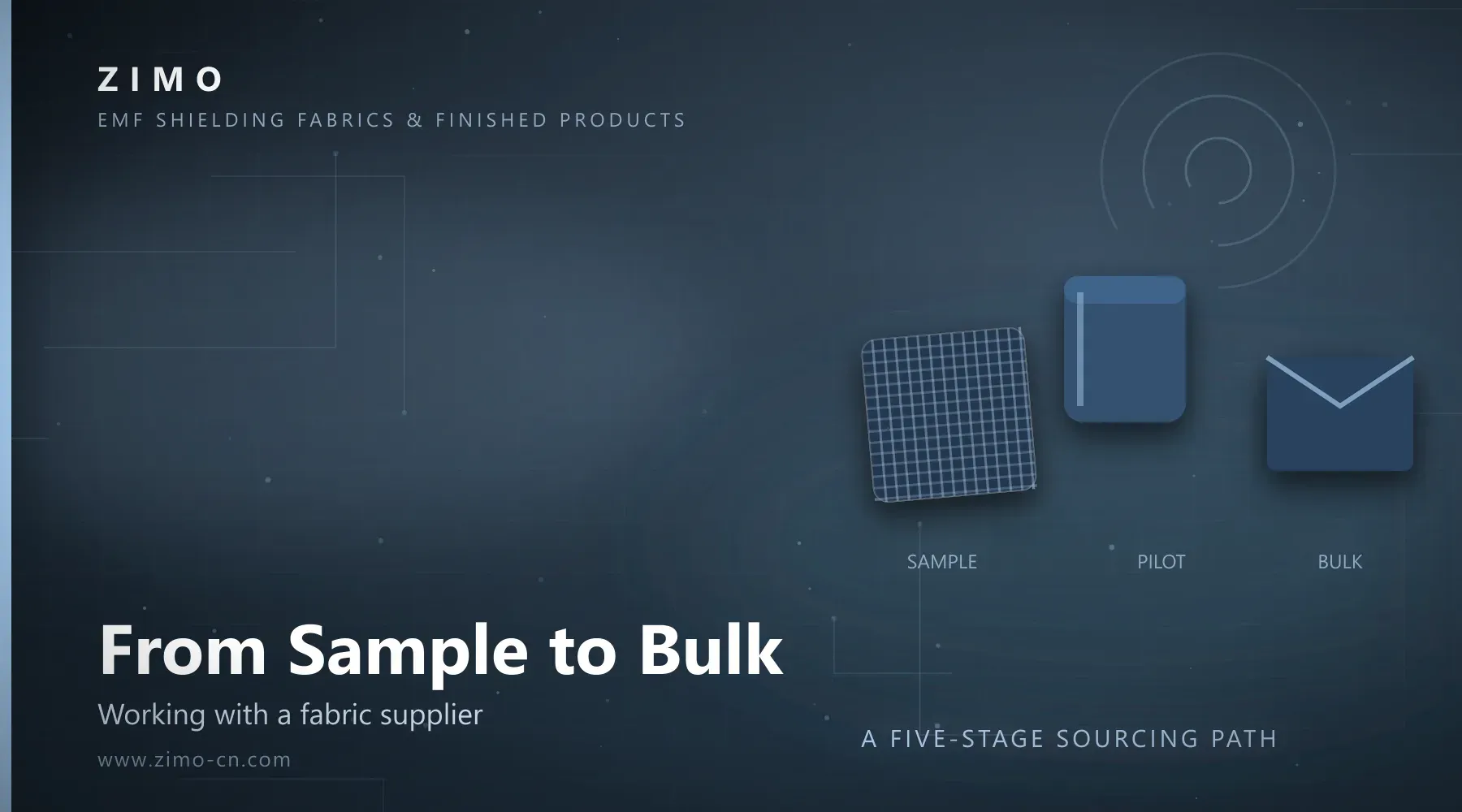
Buying shielding fabric for the first time is not like buying ordinary textiles: the property you are paying for — shielding attenuation — is invisible. This guide lays out the fabric sample to bulk order process in five stages: what to do at each stage, what your supplier should hand over, and the questions worth asking before you move on — written for manufacturers and brands using conductive fabrics in wallets, bags, apparel, workwear and home textiles.
The Fabric Sourcing Process at a Glance
Most sourcing problems come from advancing a stage early: pricing before the application is defined, or volume before a pilot run. The table below is the fabric supplier workflow we recommend and follow.
Stage | What you should do | What your supplier should give you
1. Define requirements | Specify the application, frequency bands of concern, weight (GSM) and width | Clarifying questions and a shortlist of suitable fabrics
2. Review documentation | Read the spec sheet; check what test conditions the figures refer to | Written specs, manufacturer-tested attenuation ranges, test reports on request
3. Sampling | Order standard samples (no MOQ); assess hand feel, thickness, processability | Samples plus honest notes on stiffness, drape, limitations
4. Small batch | Run a pilot to verify yield, wastage and processing | Material consistent with the agreed specification
5. Bulk order | Agree MOQ and acceptance criteria in writing | Batch-level test reports as the acceptance basis
Stage 1: Define the Application Before Asking for a Price
A shielding fabric is chosen backwards from the application: a wallet or bag liner needs a thin, flexible conductive layer; garments need a weight and drape your cutting tables can handle; workwear and home textiles differ again. Four inputs decide most of the outcome:
Application — what the fabric becomes, and how it is cut, sewn and used.
Frequency band — attenuation is measured at specific frequencies; a dB number without a band is incomplete.
Weight (GSM) — affects performance, drape and how the fabric runs through your machines.
Width — determines cutting efficiency and wastage.
Questions for the first conversation:
Which frequency bands does my application actually need to attenuate?
What weight and width can my existing process handle without retooling?
Does the fabric need to survive washing, folding or lamination?
Stage 2: Ask for Data, Not Adjectives
Documentation separates suppliers who can support you from suppliers who can only sell. Ask for a spec sheet, attenuation data with stated test conditions, and test reports where they exist. Zimo's manufacturer-tested figures for its standard conductive fabrics read like this:
Copper Nickel Fabric: 60–90 dB shielding attenuation, manufacturer-tested; test reports available on request for some specifications.
Silver Fiber Fabric in denser specifications: 50–80 dB. The more open Silver Fiber Mesh: roughly 20–40 dB, in a lighter construction.
Stainless Steel Fabric: specified by verified physical characteristics — thick, fairly stiff, almost no stretch — suiting shirts, trousers and outerwear. No dB figure is quoted.
Every range above is manufacturer-tested data with its qualifier attached; for scale, the standard conversion puts 40 dB at about 99.99% attenuation. For how such numbers are produced, see how shielding effectiveness is measured.
Before approving a datasheet, ask:
What test method and frequency range do these figures refer to?
Can I get the test report for the exact specification I would buy?
Stage 3: Sampling — Why No MOQ Matters
Zimo's standard products carry no MOQ: order a few dozen meters of any standard fabric and test it in your real application. The cost of trial and error stays low, so you can compare a copper nickel weave, a silver fiber option and a stainless steel construction side by side on your own line. For small projects, that is the difference between testing three options and committing to one on faith.
What to verify on a sample:
Hand feel, thickness, stiffness and drape against your requirements.
Cuttability and sewability on your actual equipment.
Attenuation under your own conditions, if you have measurement equipment or lab access.
Custom fabric development starts here too: the safest customization begins from an already-tested specification and changes one variable at a time.
Questions to ask:
Which standard fabric is closest to my target specification?
What exactly should I measure before approving this sample?
What changes between the sample lot and a production lot?
Stage 4: The Small Batch Is Not Optional
A pilot batch verifies two things a sample cannot: yield and process. At production speed, fabric behaves differently — tension, cutting wastage and seam behavior show up only in volume. The pilot turns "the sample worked" into "our line can produce this at an acceptable defect rate."
Questions to ask:
What defect rate should we plan for and tolerate?
Is the pilot lot held to exactly the same specification as the approved sample?
Stage 5: Bulk Orders and Custom Fabric Development
Customization comes in two honest tiers:
Modify an existing specification. Weight, width or blend adjustments to a fabric that already exists with test data. Shorter path: the base construction and its measurements are known.
Develop something new. A new construction means a longer development cycle, its own testing and more uncertainty. Worth it when the application genuinely demands it — but plan it as a development project, not a purchase order.
Standard products have no MOQ; customizations in size, weight or style carry a MOQ determined per requirement. Sample costs and lead times depend on the specification and current policy, so our sales team confirms them once requirements are clear. Finished products — hats in four styles, blankets, underwear, aprons, scarves, work uniforms, anti-scanning phone pouches and RFID blocking bags — are available OEM/ODM.
Before signing, ask:
Is my request a modification of an existing spec or a new development?
Which test reports and acceptance criteria govern each bulk batch?
Retest When the Specification Changes
Attenuation data belongs to a specification, not to a fabric name. If weight, width, weave or blend changes at any point — even between sample and bulk — the old figures no longer describe the material. Write retesting into your fabric sourcing process as a formal step; that discipline is what keeps a fabric sample to bulk order project honest.
Three Pitfalls That Turn a Good Sample Into a Bad Order
Comparing price without comparing methodology. A dB figure measured under one set of conditions is not comparable with a number measured under different ones. Compare test conditions first, price second.
Skipping the small batch. Sample-to-bulk means your first production run absorbs all the process risk the pilot was meant to catch.
Treating sample performance as a bulk promise. Bulk is accepted against the batch's own test report, not the sample's. Agree that basis before the purchase order, not after a dispute.
FAQ
How long does sampling take, and does it cost anything?
Both depend on the specification and current policy. Our sales team confirms sample costs and timelines once your requirements are clear — a specific answer for a specific fabric beats a generic promise.
How is the MOQ for custom fabrics calculated?
Per requirement. Standard products have no MOQ; customizations in size, weight or style carry an MOQ set by what the change involves, confirmed during requirement definition.
Can I buy just a few dozen meters?
Yes, for standard products. No MOQ means you can buy small quantities, test them in your real application, and scale up only when the fabric has proven itself.
What if bulk performance differs from the sample?
The governing reference is the test report of the batch you receive, not the sample. Agree acceptance criteria and the test method before the bulk order; if batch data falls short, you have a documented basis to escalate.
What does Zimo make besides fabric?
Conductive shielding fabrics — copper nickel, silver fiber and stainless steel — plus finished products: EMF protection hats in four styles, blankets, underwear, aprons, scarves, work uniforms, anti-scanning phone pouches and RFID blocking bags. Finished goods are available OEM/ODM.
Start With a Sample
A few sentences on what you are making, the frequencies you care about and the weight you need are enough for us to recommend a fabric and its data package. Start with a sample — tell us your application.
Related Reading
Start an EMF Protection Brand
How Shielding Effectiveness Is Measured
RFID Blocking Fabric for Wallets