Oct 3, 2026B2B Sourcing
EMF Protection Working Uniform: OEM Shielding Workwear Guide
OEM guide to EMF protection working uniforms: zoned copper-nickel and silver-fiber fabrics (60–90 dB / 50–80 dB, manufacturer-tested), sampling and MOQ.
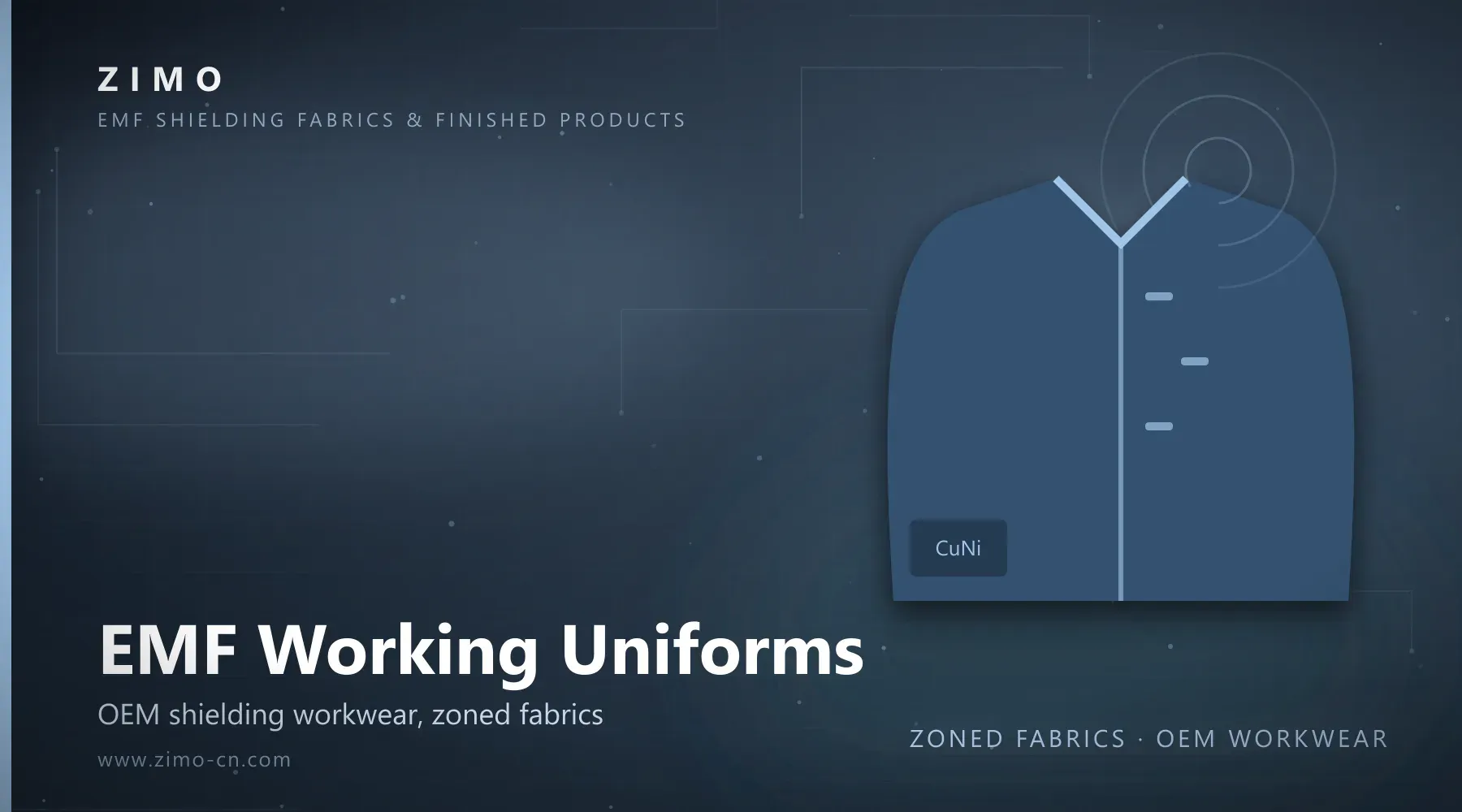
An EMF protection working uniform is workwear sewn wholly or partly from conductive shielding fabric that attenuates radio-frequency (RF) signals across the zones it covers. In sourcing documents the category also appears as EMF shielding workwear or, in some markets, an anti radiation uniform — the construction logic and buying process are the same either way. This guide explains how these uniforms are built, what an OEM project with Zimo involves, and what to confirm before you commit to a specification.
What Is an EMF Protection Working Uniform?
The category sits between consumer shielding apparel and certified protective equipment: a working uniform is produced to a defined style, size system and fabric specification, then issued to a team at scale. Typical usage scenarios include:
Maintenance technicians working around high-frequency equipment
Electronics manufacturing floors where RF process equipment runs alongside production
Laboratory settings with active RF sources
Telecom field operations near antenna installations
These are illustrative examples of RF-dense work environments, not a statement about any industry's regulatory requirements. Whether a given workplace should issue shielding garments is a decision for the buyer's own assessment and internal policies.
An Honest Positioning Statement
Shielding uniforms are supplementary garments — where workplace RF safety regulations require certified PPE, they do not replace it.
Zimo manufactures EMF shielding workwear from conductive fabrics and reports attenuation figures from our own production testing. We do not present these garments as certified personal protective equipment, and we make no medical or health claims. For procurement teams, this keeps the scope clear: what you are buying is a garment whose fabric attenuates RF signals within tested bands, specified as a supplement to your existing workplace RF-management program.
Zoned Fabric Construction: How the Uniform Is Built
High attenuation and all-day wearability pull in different directions. Structured, high-shielding panels perform best in fixed zones, while soft, breathable fabric is needed wherever the garment flexes or touches skin. Production uniforms therefore commonly use zoned construction — mapping different fabrics to different panels of the same garment (see our EMF shielding fabric guide for a broader material comparison):
Uniform zone | Recommended fabric | Shielding attenuation (manufacturer-tested) | Why it fits
Front placket, chest pocket panels and other fixed front zones | Copper Nickel Fabric | 60–90 dB; test reports available on request | Highest attenuation in our fabric range; stable construction suits structured panels
Body, sleeves, collar — skin-contact and high-mobility areas | Silver Fiber Fabric, dense grade | 50–80 dB; test reports available on request | Soft, breathable and skin-friendly; naturally antibacterial; drapes well in movement
Optional back or ventilation panels | Silver Fiber Mesh | Approx. 20–40 dB | Lighter mesh option for panels that do not need full-panel attenuation
For orientation, attenuation of the tested signal converts roughly as follows: 10 dB ≈ 90%, 20 dB ≈ 99%, 30 dB ≈ 99.9%, 40 dB ≈ 99.99%. These percentages describe signal attenuation within the tested frequency band — not a health outcome — and actual attenuation varies with frequency, which is why the checklist below asks you to match test bands to your environment.
All fabric figures in this article are manufacturer-tested; test reports are available on request.
OEM Capabilities: How Zimo Produces Shielding Uniforms
Zimo supplies both the shielding fabrics and the finished garments, so fabric and garment decisions stay under one roof. For OEM and ODM uniform projects we support:
Sampling to your style sheet. Send a tech pack or reference garment; we develop a counter-sample for fit and construction review.
Custom size systems. Grading built around your workforce measurements rather than a generic chart.
Logo and workwear labels. Branding and garment labels specified to your standard.
Fabric customization. Weight (GSM) and composition adjusted within the copper-nickel and silver-fiber families to balance drape, durability and attenuation targets.
Project-based MOQ. Standard catalog items carry no MOQ; custom uniform programs have a minimum order quantity determined case by case according to the customization scope.
Wider material options. Other conductive fabrics are available on request beyond the two families above.
A Pre-Order Checklist for EMF Shielding Workwear
Style and coverage requirements. Define which zones need shielding, how the garment closes, where pockets sit, and whether it layers under outerwear. Coverage drives fabric consumption and cost, so fix it early.
Attenuation caliber and test bands. Ask which frequency bands the dB figures were measured in, and request the reports. A 60–90 dB copper-nickel panel and a 50–80 dB silver-fiber panel are not interchangeable on paper; aligning test bands with your intended environment keeps comparisons meaningful.
Laundering plan. Industrial washing is the most demanding variable across a garment's service life. Conductive fabrics have care requirements, and wash method, temperature and frequency affect how the conductive structure performs over time. Share your laundering conditions during specification so we can advise the right fabric and construction.
Size gradient. Map the size distribution across your team, including allowance for clothing worn underneath. Settle the grading range before sampling so the counter-sample can be checked at both ends of the scale.
Sampling process. Standard flow: spec or tech pack → fabric confirmation against test bands → counter-sample → fit and wash review → bulk production. Timelines depend on fabric availability and style complexity and are confirmed per project.
Request a Quote
Request a Quote — share your uniform spec for a fabric & garment proposal. Include the style, coverage zones, estimated quantity and laundering conditions, and we will reply with a fabric recommendation and a sampling plan.
FAQ
Can an EMF protection working uniform replace certified PPE?
No. Shielding uniforms are supplementary garments — where workplace RF safety regulations require certified PPE, they do not replace it. Our garments are not certified PPE, and the attenuation figures we publish are manufacturer-tested data, not third-party certification.
Does industrial washing affect shielding performance?
Washing is one of the main variables in long-term performance. Copper-nickel and silver-fiber fabrics each have specific care requirements, and wash method, temperature and frequency influence how the conductive structure holds up over the garment's service life. Tell us your laundering conditions at the specification stage and we will recommend the fabric and construction that fit them.
Can you produce uniforms to our existing style?
Yes. OEM and ODM production is available: we sample from your tech pack or reference garment, build a custom size system, apply your logo and labels, and adjust fabric weight or composition where required.
How is the minimum order quantity calculated?
Standard catalog items carry no MOQ. For custom uniforms, the MOQ is determined per requirement — style complexity, fabric customization, size run and labeling all factor in — and is confirmed with the quotation.
What are the lead times and sampling steps?
Sampling follows the standard flow: spec review, fabric confirmation, counter-sample, then bulk production after your approval. Lead time depends on fabric availability, customization depth and order quantity; we confirm a schedule per project once we have reviewed your spec.
Related Reading
Copper Nickel Fabric: 60–90 dB Shielding Fabric
Silver Fiber Fabric: Soft, Skin-Friendly Shielding Fabric
Silver vs. Copper Nickel Fabric: How to Choose