Guides & Education
EMF Shielding Fabric for Telecom Base Stations and 5G Equipment Rooms
Base stations and 5G equipment rooms use shielding fabric in cabinets, around cables and as room linings, curtains and door seals. This guide covers uses, materials, grounding and testing.
EMF Shielding Fabric for Telecom Base Stations and 5G Equipment Rooms
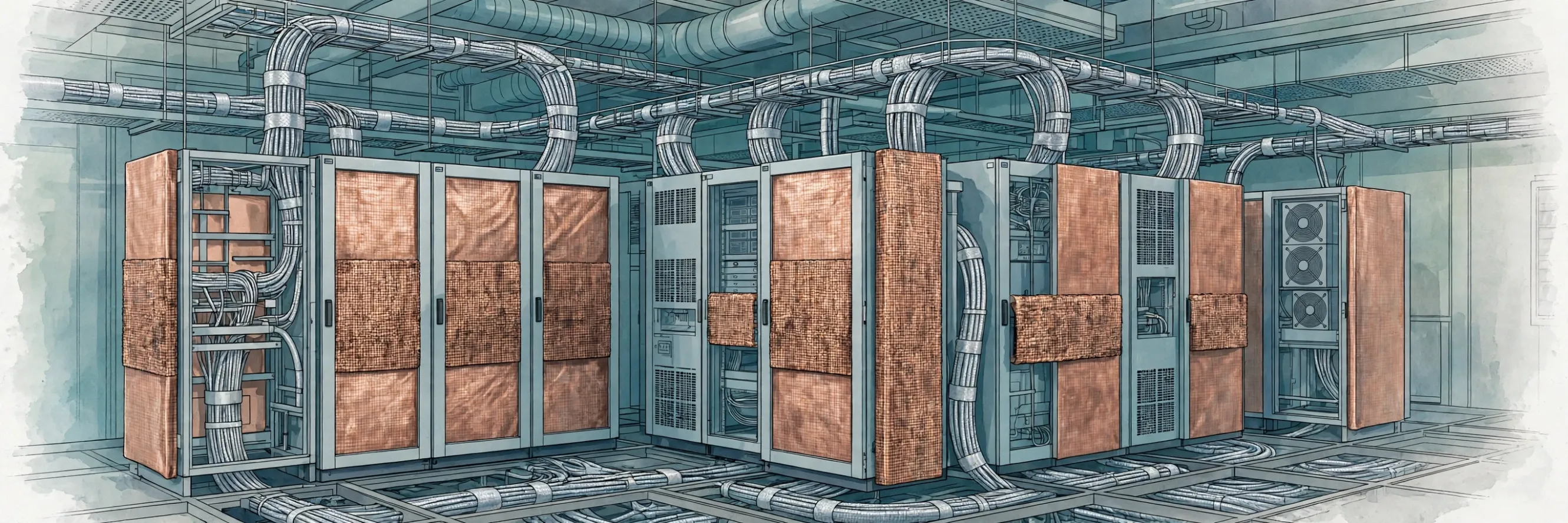
A telecom base station and a 5G equipment room hold a lot of electronics in a small space: cabinets full of equipment, cable runs between them, and a room that has to keep working around the clock. Shielding fabric is one of the materials buyers use to manage that, and it shows up in places a first-time buyer does not always expect: inside a cabinet, around a cable bundle, as a lining on a wall, as a curtain across a doorway, or as a seal around a door. This guide is for a telecom buyer, a site engineer or a project manager who is sourcing shielding fabric for a base station or an equipment room for the first time. It covers where the fabric is used, how to choose it, what to watch in grounding and installation, and how to test and sample it before ordering in bulk. It is not a telecom engineering guide: the specification and the test requirements come from your customer, and the supplier's job is to meet the brief you send, not to set the standard.
Where shielding fabric is used in a base station and an equipment room
The first use is inside cabinets: linings and covers inside equipment cabinets, and wraps around cable bundles and modules. Here the fabric is cut to shape and fixed in place, and the questions are about flexibility, thickness, and whether the shielding holds at a fold, a bend or a seam. The second use is cable management: wraps and sleeves around cable runs between cabinets, and covers where cables pass through a wall or a floor. Here the questions are about how the fabric is joined around the cable, and whether the join stays closed once the cable is in place. The third use is room lining: fabric on walls and ceilings, and curtains that divide a room or cover an opening. Here the questions are about how the fabric is fixed, how the panels join to each other, and how the room is used day to day. The fourth use is doors and openings: fabric and conductive foam as seals around doors, hatches and access panels, where the seal itself does the shielding work and has to compress, recover and keep contact every time the door closes.
A buyer who names the use in the first message saves a round of questions. A cabinet lining and a room curtain are not the same order, even if they use the same roll of fabric, because one is cut to shape and fixed inside a cabinet, the other is hung and moved, one is measured in cut pieces and the other in square metres, and the test each one needs is different. Say where the fabric will go, what it will be joined to, and how it will be fixed, and the supplier can propose a fabric instead of guessing one.
Choosing the material
Copper-nickel fabric is listed at 60 to 90 decibels in the product guides on this site, and it is the usual choice for cabinet linings, cable wraps and room linings, because it is flexible, light and easy to cut, bond and sew. Conductive foam, used for gaskets and seals around doors, hatches and access panels, is listed above 75 decibels. Silver fibre fabric is listed at 50 to 80 decibels, and it is the usual choice where a softer hand feel or a textile finish matters, for example in curtains and soft linings that people handle. Those ranges are a starting point for discussion, not a promise for your finished installation, because the shielding a room or a cabinet reaches depends on the shape, the seams, the bonding, the closures and the grounding as well as the roll of fabric. Name the shielding target and the test you want in the same message, and ask for the test result in writing, with the test method named. Test reports and supplier certificates are available on request.
When you choose, think about what the material has to survive after it is fitted. A cabinet lining is fixed once and left alone, so ease of cutting and fixing matters most. A cable wrap is folded around a bundle, so flexibility matters more than anything else. A room curtain is opened and closed every day, so durability at the fold and the edge matters. A door seal is compressed and released every time the door closes, so recovery matters more than the number on the roll. Tell the supplier how the material will be fixed, joined and used, and ask which fabric they would propose for that use, rather than choosing from a name alone.
Grounding and installation: what to agree before you order
Shielding fabric works as a system, not as a roll. A lining that is not joined properly, a curtain that leaves a gap, or a door seal that does not make contact will shield less than the fabric on its own, whatever the number on the roll says. Before you order, agree with your site team how the fabric will be fixed, how the panels will join, how the seams and overlaps will be made, and how the installation will be connected to ground. The grounding method and the grounding points are part of the specification, and they come from your customer or your site design, not from the fabric supplier. If your customer has a specification document, send the pages that apply to the fabric and the installation, rather than describing them in your own words, so the supplier works against the right requirement.
Then plan the installation like a job, not like a delivery. Confirm who cuts the fabric and who fits it, whether it arrives as a roll or cut to size, how the edges are finished, and how the joins are made on site. A room lining that arrives as a roll needs cutting and finishing on site; a curtain that arrives cut to size needs its fixings and its edges agreed in advance. Agree how the finished installation will be checked, and who checks it, before the fabric is ordered, so the check is not invented after the work is done. Tell the supplier the size of the room or the cabinet, the width you need, and how the fabric will be fixed, so the quantity is quoted in the right unit and the sample matches the job.
Testing and samples: test the finished piece, not the roll
The test list for a base station or an equipment room starts with shielding, and it should not end there. Agree before sampling what will be tested, on which part of the finished piece, and after what treatment, because a test result without a method is a sentence, not a specification. For a cabinet lining or a cable wrap, the shielding test should be run on the finished, joined piece, not on a flat piece of fabric, because the seams and the folds are part of the result. For a room lining or a curtain, the test should cover the joined panels, the overlaps and the edges, because a gap between panels is part of the result too. For a door seal, test the seal as fitted, closed and opened, because the contact when the door closes is the product.
Then agree the durability checks your customer requires and name them in the brief, with the pass result for each one. Do not assume a document that applies to a roll of fabric automatically applies to a finished installation in your market, and do not assume a supplier's test report replaces your customer's approval. The boundary here is simple: the supplier can propose a fabric, supply a sample and report a test result in writing. The decision about whether that result meets your customer's specification is yours and your customer's. If your market needs a specific document, name it in the brief and ask what the supplier can provide with the sample.
Samples, quantities and what to check
Fabric can be ordered from as little as 1 square metre. The suggested starting quantity is 10 square metres or 10 metres, with a better price for a larger quantity, and silver fibre fabric is usually priced by the square metre while copper-nickel fabric is usually priced by the metre. Finished products in stock can be ordered from 1 to 2 pieces, while an out-of-stock item needs a new quotation and lead time. Say whether you are ordering fabric by the roll or finished goods, give the width, and say whether the fabric will be cut, sewn, bonded or hung, because each one changes the quantity and the sample you should ask for.
A stock sample usually ships in 1 to 5 days, while a custom sample usually takes 5 to 30 days depending on the process, and the exact time is confirmed once the specification is confirmed. Order the sample before you promise your customer a delivery date. When it arrives, check the fabric, the edges, the seams and the joins first, then run the agreed shielding and durability checks on the finished piece, and keep the result with the sample. Ask for the documents you need with the sample, not with the bulk order, so a missing document is found while the order is still small. Decide the labelling before the sample is cut if the goods carry your own brand, in the language and wording your market expects.
Payment is by letter of credit, telegraphic transfer, PayPal or Western Union. Confirm the method and the currency before the order is placed. Yiwu Zimo Trading Company is a trading-and-manufacturing supplier. The details above describe how it quotes and samples. They do not describe factory capacity or production processes, which are not published, and they do not promise a shielding level for a part that has not been tested.
Frequently asked questions
Where is shielding fabric used in a base station or a 5G equipment room?
In linings and covers inside equipment cabinets, in wraps around cable bundles, in linings on walls and ceilings, in curtains that divide a room or cover an opening, and in seals around doors, hatches and access panels. Name your use in the first message, because the material and the test depend on it.
Which fabric should we use?
Copper-nickel fabric, listed at 60 to 90 decibels, is the usual choice for cabinet linings, cable wraps and room linings. Silver fibre fabric, listed at 50 to 80 decibels, is the usual choice where a softer hand feel matters, such as curtains and soft linings. Conductive foam, listed above 75 decibels, is used for gaskets and seals.
What should we agree about grounding and installation?
How the fabric is fixed, how the panels join, how the seams and overlaps are made, and how the installation is connected to ground. The grounding method comes from your customer or your site design, not from the fabric supplier.
What should we test on the sample?
The shielding test on the finished, joined piece, including the seams, overlaps and edges, and the durability checks your customer requires, agreed before sampling, with the test method named and the result in writing.
How long does a sample take?
A stock sample usually ships in 1 to 5 days. A custom sample usually takes 5 to 30 days depending on the process, and the exact time is confirmed once the specification is confirmed.
Your next step
Write a one-page brief with the use case, the fabric, the shielding target and the test method, how the part will be cut, sewn, bonded or hung, the quantity in the unit the supplier prices in, the width, the grounding and installation method your site design requires, the documents you need, and the payment method and currency. Send it and ask the supplier to confirm the fabric, the sample time, the test that will be run on the sample, and what is included in the sample price. When the sample arrives, test the finished piece before you approve bulk. If you are ready to start, contact us through the contact page or email info@zimo-cn.com with your brief, and we will reply with a fabric proposal, a sample time and a quote.