Oct 3, 2026Home & Living
EMF Protection Blanket: How It Works and How to Choose
How an EMF protection blanket works, what dB ratings mean, and how to pick an anti radiation blanket for a lower-exposure rest spot.
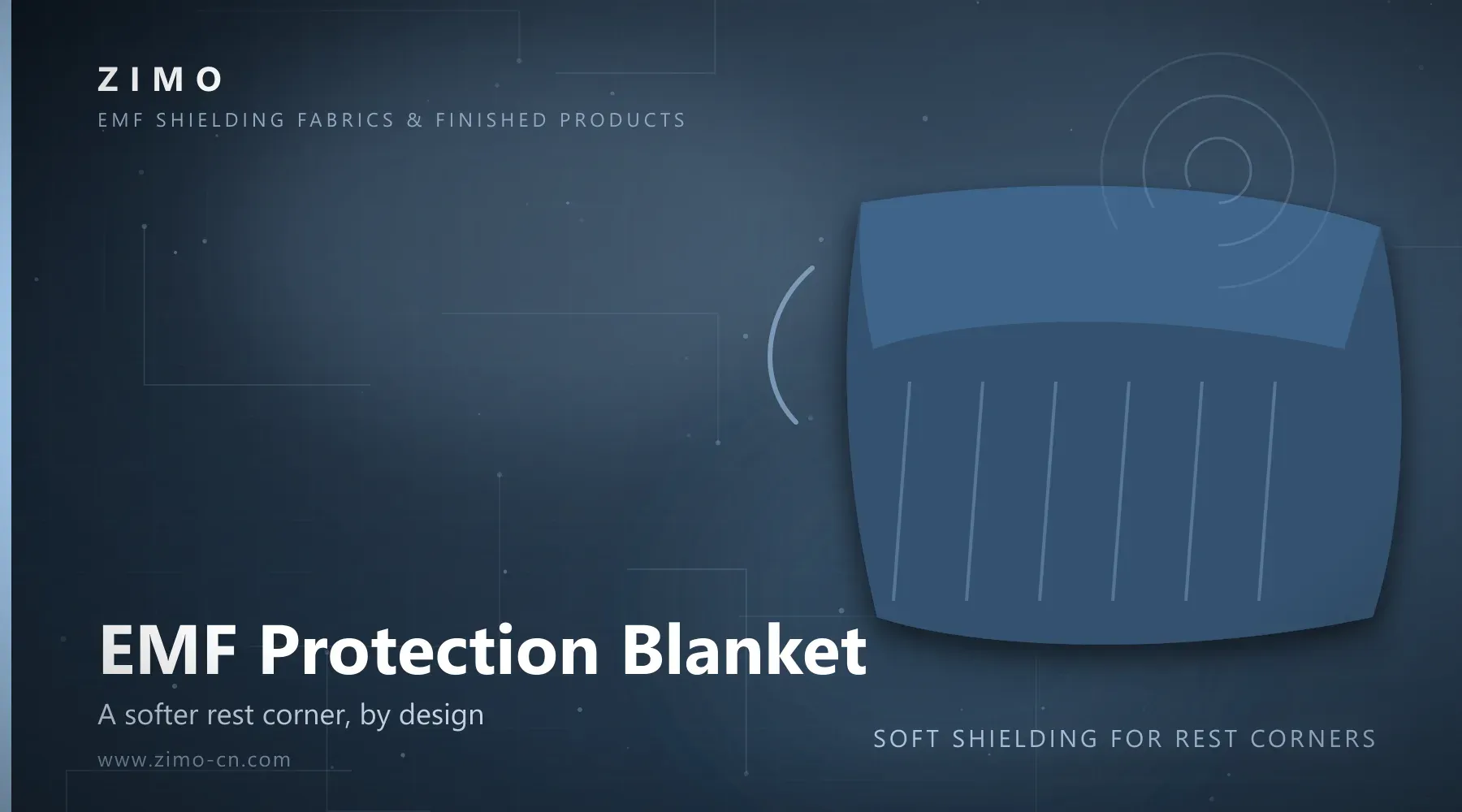
An EMF protection blanket is a simple way to build a lower-exposure rest spot in an otherwise ordinary room. Instead of shielding a whole bedroom, you shield the space a blanket covers — a lap, a sofa corner, a stroller. This guide explains how they are made, what dB ratings actually measure, where people use them, and how to compare options, whether for home use or a product line.
What Is an EMF Protection Blanket?
An EMF protection blanket is a composite textile: a shielding layer inside, most commonly a conductive fabric woven with silver fibers, and soft ordinary textile layers outside so it feels like a blanket, not a technical sheet.
The shielding layer works because continuous silver threads form an electrically conductive network. When radio-frequency (RF) energy from phones, routers and other wireless devices reaches the fabric, the network reflects most of it and absorbs a little, so far less passes through to the covered side. In specs, this is shielding effectiveness in decibels (dB).
A Local Shield, Not a Whole-Home Shield
A blanket shields the area it covers, nothing more. Where fabric overlaps — folds, wraps, layered edges — attenuation is stronger. Along open edges, RF energy simply enters around the sides. That is normal for any fabric shield: a blanket is local, personal coverage, not a substitute for treating an entire room.
Where People Use an Anti Radiation Blanket
Because it is portable, an anti radiation blanket (also called an RF shielding blanket) works in more places than a bed. Common scenarios:
A throw for the sofa or bed, for resting or napping under partial coverage
Draping over the lap while working with a laptop
A cover over a stroller while outdoors (see the FAQ below for sizing and airflow)
Wrapping around the shoulders or legs during evening screen time
These uses are popular with people who want to create a lower-exposure rest spot for themselves or their families. To be plain: it is a comfort and preference choice, not a medical intervention.
Inside the Blanket: Silver Fiber Shielding Fabric
For blankets, the dense silver fiber fabric is the workhorse material. Denser silver fiber specifications are manufacturer-tested at 50–80 dB shielding effectiveness, and test reports are available on request. Silver fiber is also soft against the skin and naturally antimicrobial, which suits blankets and wearables that sit close to the body.
dB is a logarithmic scale, so small numbers mean a lot. As a standard conversion: 10 dB attenuates about 90% of incident RF energy, 20 dB about 99%, 30 dB about 99.9%, and 40 dB about 99.99%. A fabric tested at 50–80 dB sits well above that 99.99% mark — on the tested bands. Always ask which frequency bands a figure was measured at; Zimo's figures are manufacturer-tested, and test reports are available on request. For a deeper material comparison, see our EMF shielding fabric guide.
How to Choose an RF Shielding Blanket
Five practical criteria cover most purchase decisions:
Size and Coverage
Measure the real use. A lap needs far less fabric than a double bed, and a blanket you actually use beats a large one that stays folded. Check the dimensions and decide whether you want spare fabric for wrapping.
Shielding Level and Test Reports
Ask for the dB figure, the frequency bands tested and the test method. Manufacturer-tested figures are legitimate, but a seller should produce a report on request. If nobody can show test data, treat the number as marketing copy.
Outer Fabric and Comfort
The shielding layer does the technical work; the outer layers decide how it feels. Look for a soft, breathable shell, tidy edge binding, and construction that keeps the conductive layer evenly distributed.
Weight and Breathability
A dense, high-dB fabric plus thick outer layers gets heavy and warm. For year-round use, check total weight (GSM) and airflow, especially for stroller covers.
Washing and Care
Silver fiber fabrics have real washing limits: harsh detergents, bleach and fabric softener can degrade conductivity over time. Read the care label before buying and pick a blanket whose instructions you can follow.
What an EMF Blanket Can and Cannot Do
Two honest points worth knowing before you buy.
First, edges leak. A fabric shield is strongest where layers overlap and weakest at open edges, so coverage under a blanket is not the same as a sealed box.
Second, covering a phone with the blanket does not guarantee the phone loses signal. Attenuation depends on the frequency band, the number of layers between the phone and outside, and how the edges fold. Wrapped in several folds, a phone may show a much weaker signal; under loosely draped fabric it may barely change. If a listing claims total blocking or 100% protection, treat that as a red flag — real shields are specified in dB at defined frequencies, with test data behind them.
And to be equally plain about limits: a blanket is a comfort and preference product. We make no medical or health claims for it.
For Brands and Sellers: OEM EMF Blankets
Zimo supplies silver fiber shielding fabric and finished EMF protection products — blankets, hats, underwear, aprons, scarves and working uniforms — to brands and e-commerce sellers.
Standard products carry no MOQ, so you can test demand with small orders. Blankets can be customized in size, fabric weight (GSM) and style, with a MOQ agreed per custom project. Finished blankets are available OEM/ODM, including private label, and other conductive fabrics are available on request. Order samples and current test reports before you commit to production.
FAQ
Can I put an EMF protection blanket over a stroller?
Smaller RF shielding blankets are used as stroller covers, but size and airflow matter more than raw dB. Choose a size that drapes without sealing the stroller, leave ventilation openings, and never fully enclose a child. In hot weather, a lighter silver fiber mesh (manufacturer-tested at roughly 20–40 dB) trades some shielding for better airflow. No health promises are made for children — a cover is a comfort choice.
Is an EMF protection blanket machine washable?
That depends on the fabric construction and outer layers, so follow the manufacturer's care label. As a rule, silver fiber fabrics prefer gentle handling: mild detergent, no bleach, no fabric softener, air drying — aggressive washing reduces conductivity over time. If a listing omits care instructions, ask before you buy.
Can an EMF blanket completely block my phone signal?
Complete blocking is not a realistic specification. Attenuation depends on frequency band, layer count and how well the edges overlap. A phone may keep a weak connection under loosely draped fabric and lose it wrapped in several folds. Judge a blanket by its tested dB figures and the bands measured, not by whether an app still loads.
Will an EMF protection blanket feel hot in summer?
It depends mainly on the outer fabric and total weight, not the shielding layer itself. A breathable cotton-blend shell and lighter GSM construction stay comfortable; a thick, heavy blanket will feel warm. In a hot climate, ask about lighter constructions or mesh options.
Contact Zimo about EMF Protection Blankets
Whether you want one blanket for home use or a private-label range for your store, the first step is the same: tell us what you need. Personal buyers: contact us about retail availability for standard EMF protection blankets. Brands and sellers: contact us about OEM and ODM production, custom sizes and fabrics, and samples.
Related Reading
Silver Fiber Fabric: Specs, Shielding Levels and Applications
EMF Protection Underwear: A Practical Buyer's Guide
EMF Shielding Fabric Guide