Oct 3, 2026EMF Shielding
EMF Bed Canopy: Shielding Mesh for a Lower-Exposure Sleep Space
An EMF bed canopy made of silver fiber mesh creates a lower-exposure sleep space. See how 20-40 dB shielding mesh works and how to choose the right size.
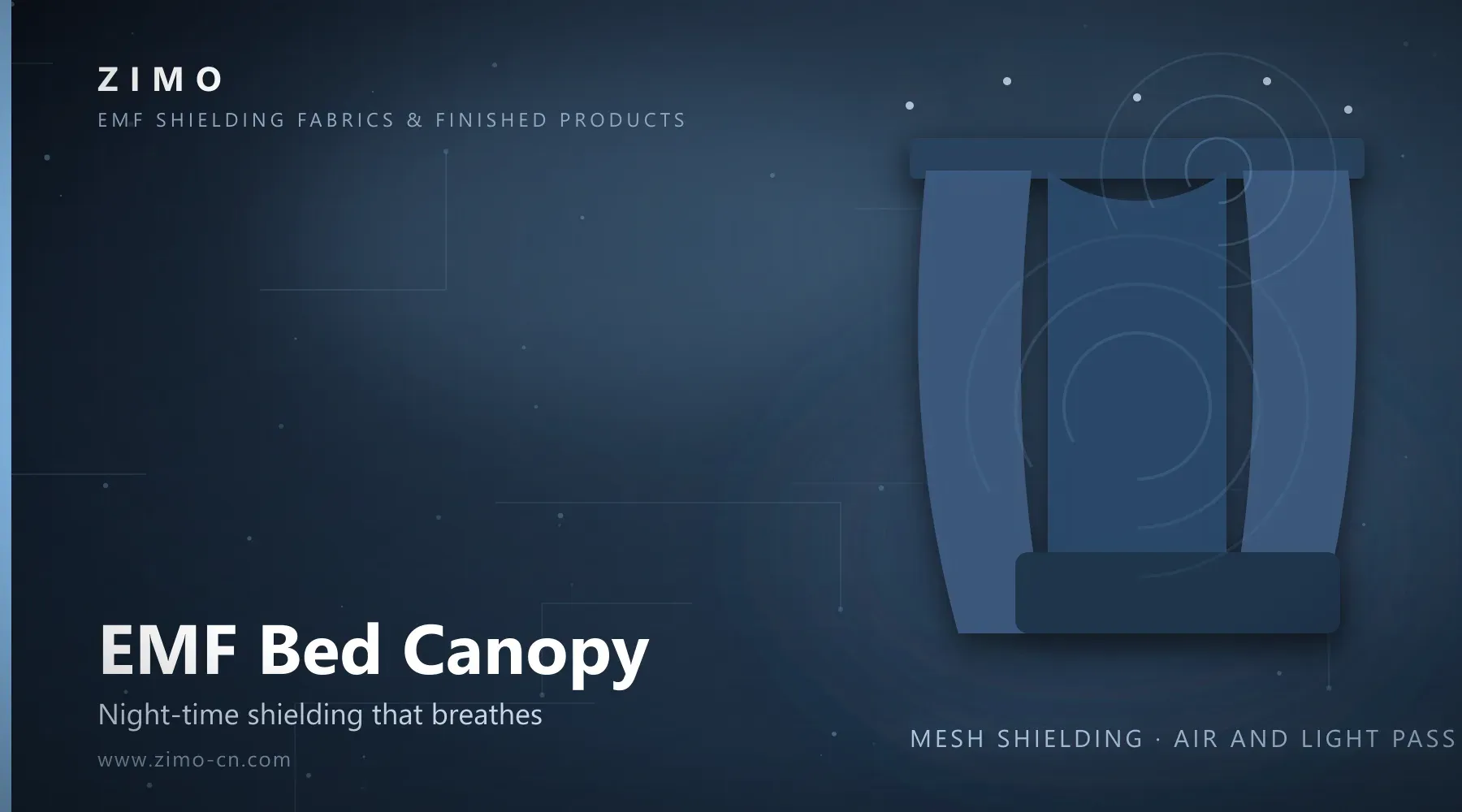
A phone charging at the bedside, a router in the next room: much of the radio-frequency (RF) activity around us follows us to bed. An EMF bed canopy is one of the most practical responses: a canopy of conductive shielding mesh hangs over the bed and creates a local, lower-exposure sleep space, without rewiring the bedroom or covering its walls. This guide explains how a silver fiber canopy works, what it can and cannot do, and how to choose one.
What Is an EMF Bed Canopy?
An EMF bed canopy is an enclosure of electrically conductive fabric—in Zimo's case, silver fiber mesh—suspended above and around the bed so the sleeping area sits inside it. The same idea is also sold as an anti radiation mosquito net, an RF shielding canopy, or an EMF canopy bed setup; the principle is identical: instead of shielding the whole room, you shield the space where you sleep.
Silver fiber mesh suits this use because it solves the comfort problem: dense fabrics measure well, but nobody wants to sleep under a tarp. A knitted silver mesh is soft, breathable, and light-permeable, so the bed does not feel enclosed; silver is also naturally antibacterial, useful for a textile that hangs over a bed for years.
Why Mesh Instead of Dense Shielding Fabric?
Conductive fabrics sit on a spectrum:
Dense fabrics such as copper nickel fabric reach manufacturer-tested attenuation of roughly 60–90 dB, which suits curtains, clothing, and structural uses where airflow matters less.
Silver fiber mesh tests in the range of about 20–40 dB (manufacturer-tested; test reports available on request), trading some attenuation for breathability, light transmission, and all-night comfort.
In decibel terms, 20 dB corresponds to roughly 99% attenuation at the tested frequency, 30 dB to about 99.9%, and 40 dB to about 99.99%. These are substantial reductions, but note the caliber: manufacturer test results, not third-party certification, and attenuation varies with frequency.
For a canopy the trade makes sense: it covers a large area, hangs in open air all night, and must stay comfortable in every season.
What a Canopy Can and Cannot Shield
Here is what many product pages skip: a canopy shields the enclosed space, not the bedroom.
A canopy works as a partial enclosure: signals are attenuated as they pass through the mesh, but every opening is a potential leak path. In real bedrooms the weak points are:
Seams and joins between fabric panels
The entry opening, especially where it does not overlap
The gap between drape and mattress or floor, where signals enter from the sides or below
That is why two canopies of the same mesh perform differently: results depend on how well the enclosure is closed, from a size that lets the drape fall past the bed's edge toward the floor, to overlap where fabric meets mattress, to entry flaps kept closed once you are inside.
A well-set-up canopy creates a lower-exposure sleep space, not a sealed Faraday cage. Any seller promising total shielding from a canopy is overstating the product form.
How to Choose an EMF Bed Canopy
Size and fit
Canopy sizing differs for a single bed, a double or larger bed, and a crib. Measure the bed's length, width, and hanging height. The drape should reach the floor and fall slightly past the mattress footprint, so the fabric meets the floor outside the bed's edge rather than pulling up short. Crib canopies follow the same logic: the fabric must hang freely with margin.
Shielding data and test bands
Ask for the dB figure and the frequency range it was tested at; a claim without a tested band is incomplete. Zimo publishes manufacturer-tested figures for its silver fiber mesh, and test reports are available on request.
Door and closure design
Overlapping entry flaps that fall closed by themselves seal better than a single slit; zipper doors are convenient but add seams, so check how they are finished.
Fixing and frame
Canopies hang from a ceiling hook, a mounted frame, or a freestanding stand. Whichever you use, keep the mesh clear of your body and bedding; continuous contact wears conductive fabrics fastest.
Washability
Silver fiber mesh is more delicate than ordinary mosquito netting: hand wash with mild detergent and air dry. Machine washing and spinning can damage the fine conductive fibers.
Why People Use a Bed Canopy at Night
Many people prefer to spend sleep hours in a space with less ambient RF around them, much as they prefer a darker or quieter room; a canopy is one of the few practical ways to act on that preference. Zimo makes no health claims for this category; what the mesh does is attenuate RF signals passing into the space it encloses.
For Brands and Sellers: Sourcing Mesh Fabric and Finished Canopies
For home-textile, baby-product, and EMF-protection brands, Zimo supplies the same silver fiber mesh in two forms:
Fabric by the meter or customized (size and weight), for manufacturers who sew their own canopies, mosquito nets, or curtains
Finished canopies as OEM/ODM, produced to your design and branding
Standard products carry no MOQ; for customized orders, MOQ is confirmed per requirement. The mesh sits alongside Zimo's other silver fiber finished items, including hats, blankets, underwear, and scarves.
FAQ
Does an EMF bed canopy need to be grounded?
Not for RF shielding. Attenuation of radio-frequency signals by conductive mesh does not depend on the canopy being earthed; grounding mainly relates to low-frequency electric fields, a separate topic. If you have specific requirements, discuss them with your supplier.
Will it block my phone signal completely at the bedside?
It depends on the frequency band and how enclosed the setup is. Silver fiber mesh with manufacturer-tested attenuation of roughly 20–40 dB reduces signals substantially at the tested frequencies (20 dB is roughly a 99% reduction), but complete blocking is not a claim we make, and seams and openings always leak more than the mesh itself.
Can I wash it in a washing machine?
We recommend hand washing. Silver fiber mesh is finer than ordinary mosquito netting; machine washing, spinning, and heat can damage the conductive structure. Use a mild detergent, lukewarm water, and air dry away from direct sunlight.
Can I use a canopy over a baby crib?
Crib-size canopies are part of this category, but size and fixing come first: the canopy must fit with margin for the fabric to hang freely, be secured so it cannot fall into the crib, and stay out of the child's reach. Follow standard safe-sleep guidance for the crib setup. Zimo makes no health-effect claims for canopy use with infants.
Will the mesh snag?
It can. Silver fiber mesh is a fine conductive textile, not a rugged net. Keep sharp objects, jewelry, and pet claws away, handle the entry flaps gently, and follow the hand-wash routine. With ordinary care, it holds up well to daily use.
Contact Zimo
Individual buyers: contact us about availability. Brands, sellers, and manufacturers: Zimo supplies silver fiber mesh fabric (by the meter or customized) and finished canopy OEM/ODM, with no MOQ on standard products; visit our contact page to discuss specifications, customization, and sampling.
Related Reading
Silver Fiber Fabric: Properties and Applications
How to Wash EMF Shielding Fabric
EMF Shielding Fabric: A Practical Guide