Oct 2, 2026EMF Shielding
Copper Nickel Fabric: EMF & RFID Shielding Fabric (60–90dB)
Zimo copper nickel fabric: manufacturer-tested 60–90 dB shielding for RFID wallets, phone pouches and Faraday enclosures. No MOQ on standard rolls.
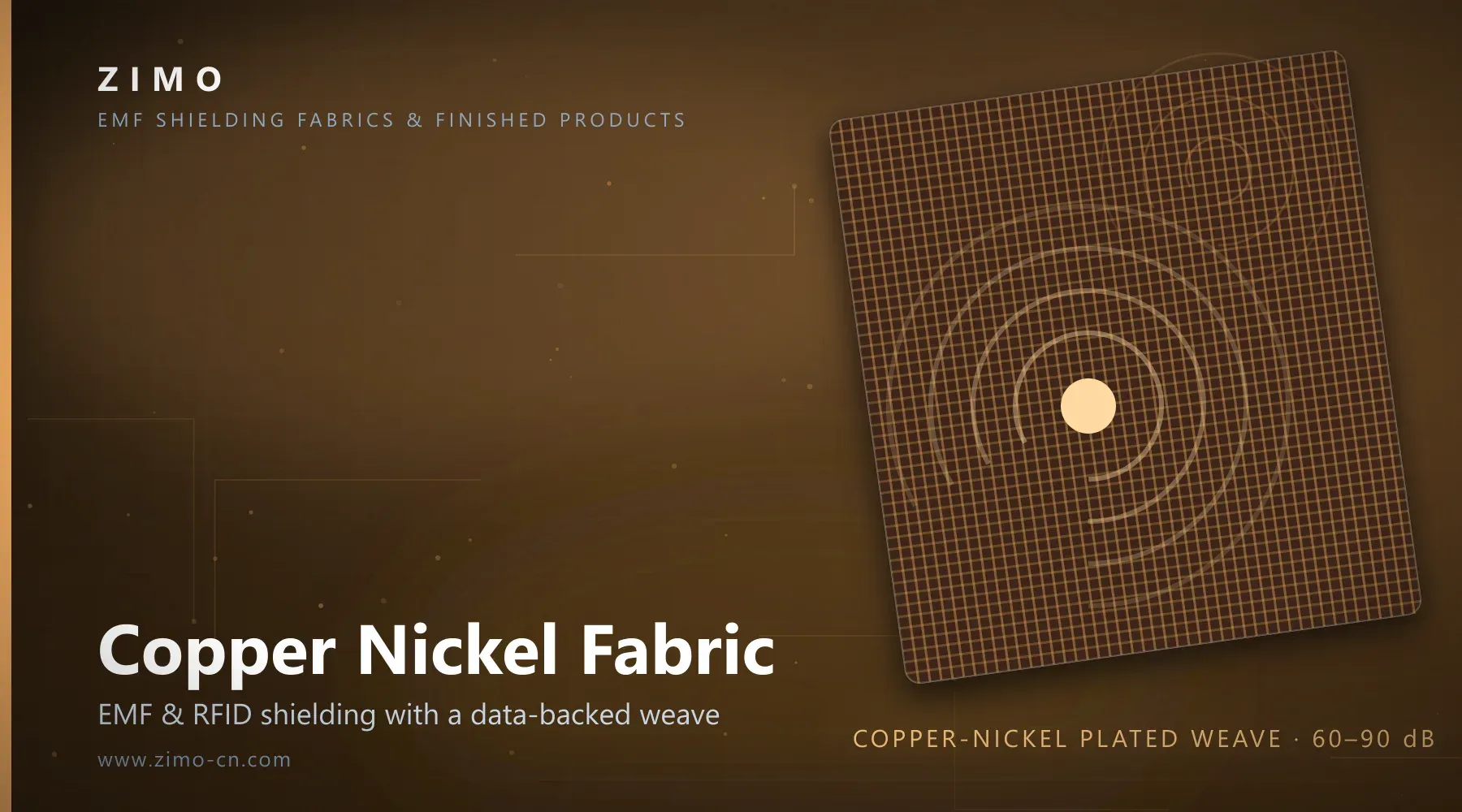
Copper nickel fabric is a conductive textile built to attenuate electromagnetic interference across a wide range of radio frequencies. Zimo's copper nickel shielding fabric is manufacturer-tested at 60–90 dB shielding effectiveness, with test reports available on request for selected specifications. That combination of high attenuation, textile flexibility and cost efficiency makes it a working material for RFID blocking wallets, anti-scanning phone pouches, compact Faraday enclosures and the linings of EMF protective apparel. Standard rolls are supplied with no MOQ, and custom sizes, weights and styles are available for brands and manufacturers.
What Is Copper Nickel Fabric?
Copper nickel fabric — often specified as Ni-Cu conductive fabric — starts from a flexible base textile. In a plating process, the textile is first coated with copper, which provides the high electrical conductivity that does most of the shielding work, then finished with a thin outer nickel layer that helps protect the copper against oxidation and surface wear. The result is a metallized fabric that behaves like a continuous conductive sheet while remaining light, foldable and easy to cut, sew or laminate.
In shielding terms, the conductive layer interacts with an incoming electromagnetic wave by reflecting most of its energy and absorbing part of what remains. When the fabric fully encloses a device or a space, it works on the same principle as a Faraday cage: signals from outside are greatly weakened before they reach the interior, and signals from inside are weakened before they escape. Because it is a textile, that enclosure can take almost any shape — a wallet pocket, a pouch, a bag or a garment lining.
What Does 60–90 dB of Shielding Mean?
Shielding effectiveness is measured in decibels (dB), a logarithmic scale: every 10 dB means the signal passing through is reduced to one tenth of its previous strength. The standard conversion looks like this:
10 dB ≈ 90% of the signal attenuated
20 dB ≈ 99% attenuated
30 dB ≈ 99.9% attenuated
40 dB ≈ 99.99% attenuated
At 60–90 dB, attenuation goes far beyond 99.99% under the tested conditions — a level more typical of technical shielding applications than of casual marketing labels. Two caveats matter for buyers. First, these figures are manufacturer-tested, not third-party certified; test reports are available on request for selected specifications, and we recommend reviewing them. Second, shielding effectiveness depends on the frequency band, the test setup and how the fabric is integrated: overlaps, seams, closures and openings all influence real-world results, which is why a well-made pouch outperforms a loosely draped sheet.
Where Copper Nickel Fabric Is Used
Because it combines high attenuation with the handling properties of a textile, copper nickel fabric is used across several product categories:
Application | Role of the fabric | Why copper nickel fabric fits
RFID blocking wallets and card holders | Protective lining between the outer material and the card slots | As an RFID blocking fabric, it attenuates contactless signals so cards inside are significantly harder to skim
Anti-scanning phone pouches | Body and lining of signal-blocking pouches | Attenuates cellular, Wi-Fi and Bluetooth signals so a phone inside a closed pouch stops communicating with nearby networks
Compact Faraday enclosures | Conductive barrier for shielded bags, pouches and equipment covers | High dB performance supports small shielded volumes with simple construction
EMF protective apparel linings | Interlining inside hats, hoods, aprons, scarves and working uniforms | Conductive yet foldable and sewable — suits lined garments better than rigid panels
Real-world attenuation depends on how completely the fabric encloses the target. A closed pouch with overlapping seams will always outperform an open sleeve, whichever fabric you choose.
Standard Supply, Customization and MOQ Policy
Zimo supplies copper nickel fabric as a standard catalogue item with no MOQ. That matters if you want to run a small trial batch, prototype a new product or test the material inside your own design before committing to volume. For projects that need specific dimensions, weights (GSM) or styles, customization is available, and the MOQ for custom orders is confirmed per requirement once the specification is agreed.
Beyond raw fabric, Zimo manufactures finished EMF protection products on an OEM/ODM basis: shielding hats, blankets, underwear, aprons, scarves and working uniforms, plus anti-scanning phone pouches and RFID blocking bags, so fabric and finished goods can come from the same supplier. Other conductive fabrics are also available on request; describe the application and we will suggest a suitable construction.
Copper Nickel vs Silver Fiber: How to Choose
In one sentence: choose copper nickel fabric when you need high attenuation and cost efficiency for wallets, pouches, enclosures or garment interlinings; choose silver fiber fabric when softness and skin comfort come first, since silver fiber is naturally antibacterial and comfortable against the skin. Many brands use both — copper nickel for structured, cost-sensitive items and silver fiber for wearables and blankets. For a detailed breakdown, see our copper nickel vs silver fiber comparison.
FAQ
Is copper nickel fabric washable, and how durable is it?
Plated conductive layers wear fastest where they are rubbed hard, folded sharply or exposed to strong chemicals. We recommend gentle hand washing with mild detergent and air drying; avoid bleach, hard wringing and high-heat drying. In wallets and pouches the fabric sits behind an outer shell, so everyday wear is limited. Durability varies by construction; test reports are available on request for selected specifications.
Will the conductive layer oxidize over time?
Copper oxidizes naturally in air and moisture — which is exactly why Ni-Cu fabric carries an outer nickel layer: it is there to slow oxidation and surface wear on the copper. Keep the fabric dry in storage and avoid prolonged contact with sweat or salt water. If your application involves humidity or sustained skin contact, ask us for care guidance and test data for your specification.
Can I place a small trial order or request samples first?
Yes. Standard copper nickel fabric carries no MOQ, so small trial quantities and sampling runs are straightforward. For selected specifications we can also provide test reports on request. Custom developments work differently: once the required size, weight and style are defined, we confirm a custom MOQ for that order.
Is copper nickel fabric effective against RFID frequencies?
RFID covers several bands: high frequency at 13.56 MHz, used by most contactless payment and ID cards, and ultra-high frequency (roughly 860–960 MHz), common in asset tracking. Shielding is frequency-dependent, so the useful question is not whether a fabric "blocks RFID" but how many dB it delivers at the band your product needs. Send us your target band and application, and we will confirm suitability and share test reports where available.
What are the lead time and sample policies?
Lead time depends on the specification, the order quantity and whether the item is standard or customized. Standard no-MOQ items move as regular production orders; custom sizes, weights or styles are scheduled after the specification is confirmed. Samples and test reports are arranged through our sales team via the contact page below.
Request a Quote or Get a Sample
If you are sourcing copper nickel shielding fabric for RFID wallets, phone pouches, Faraday enclosures or apparel linings, tell us three things: your target attenuation, the frequency band you care about and your expected order quantity. We will come back with specifications, availability and, where applicable, test reports. Request a quote or get a sample to start the conversation.
Related Reading
Silver Fiber Fabric: Soft, Skin-Friendly Shielding (50–80 dB)
Copper Nickel vs Silver Fiber Fabric: How to Choose
EMF Shielding Fabric Guide: Types, dB Ratings and Applications